ResourcesHow Stud Service Works
- Written for
- Owners of an English Bulldog female who are planning a breeding and want to know how stud service with TANK actually runs before they message us.
- Last reviewed
- 2026-10-18
- Status
- Owner reviewed, veterinary review pending
01
Who This Is For
You have a female, you have a plan for her next heat, and you are weighing TANK. Good. Here is what we need from you first.
Stud service is a pairing, not a purchase. We consider the whole pairing: what your female brings, what she may benefit from, and how the two pedigrees fit. That means we ask questions before we talk dates. The inquiry form on TANK’s page asks for your name, phone, email, her heat date, the expected breeding day, and how you want the collection done. That is enough to start the conversation.
- Her registered name, her sire and dam, and a copy of her pedigree. We walk the full pedigree with you before booking.
- Her color and pattern, including whether she is merle.
- Her age, her weight, and her general condition.
- Whether she has had a litter before, how it went, and how it was delivered.
- The first day of her current or expected heat, and which reproductive veterinarian you use.
- Where you are. It decides whether in-person collection or shipping makes more sense.
02
Meet TANK
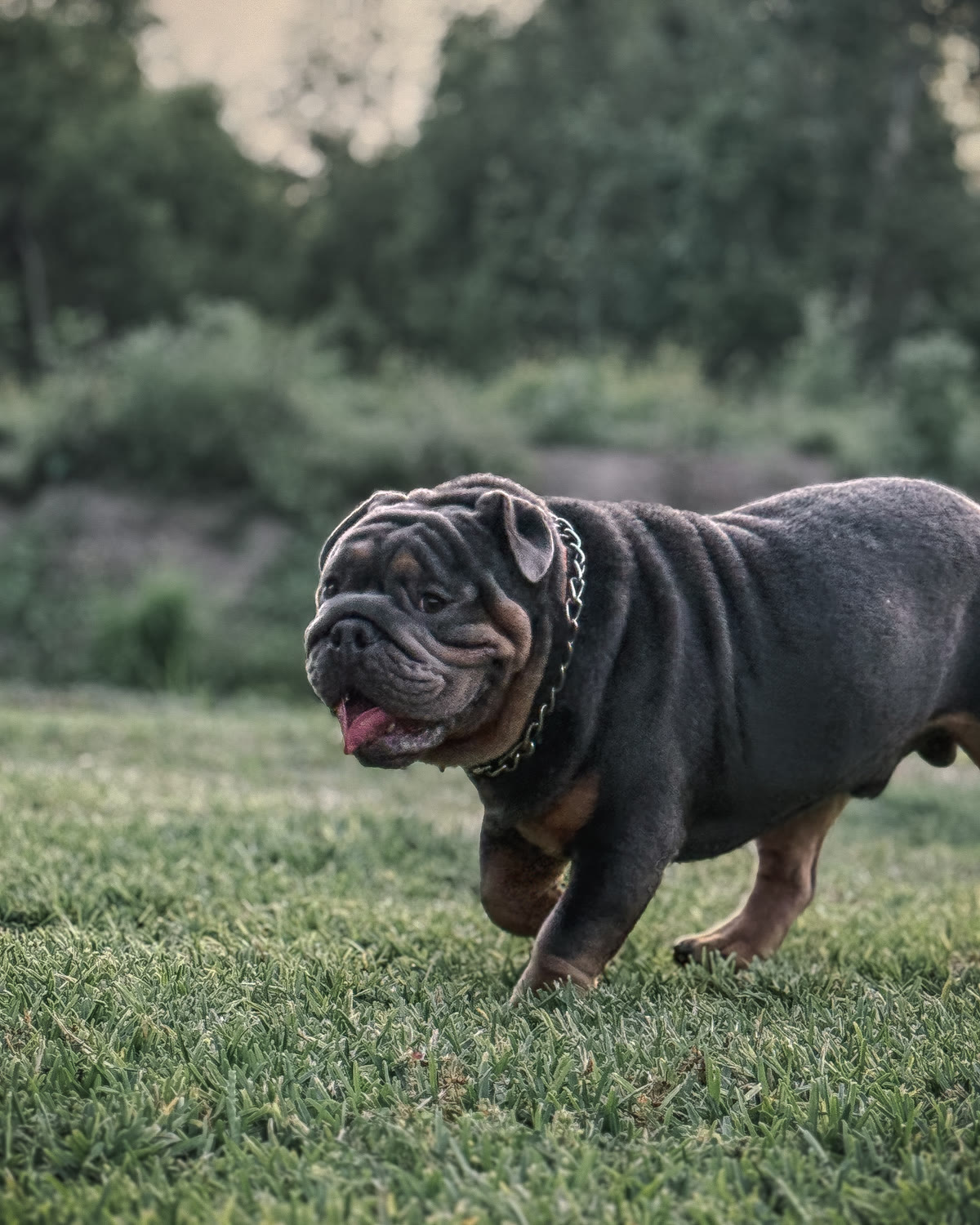
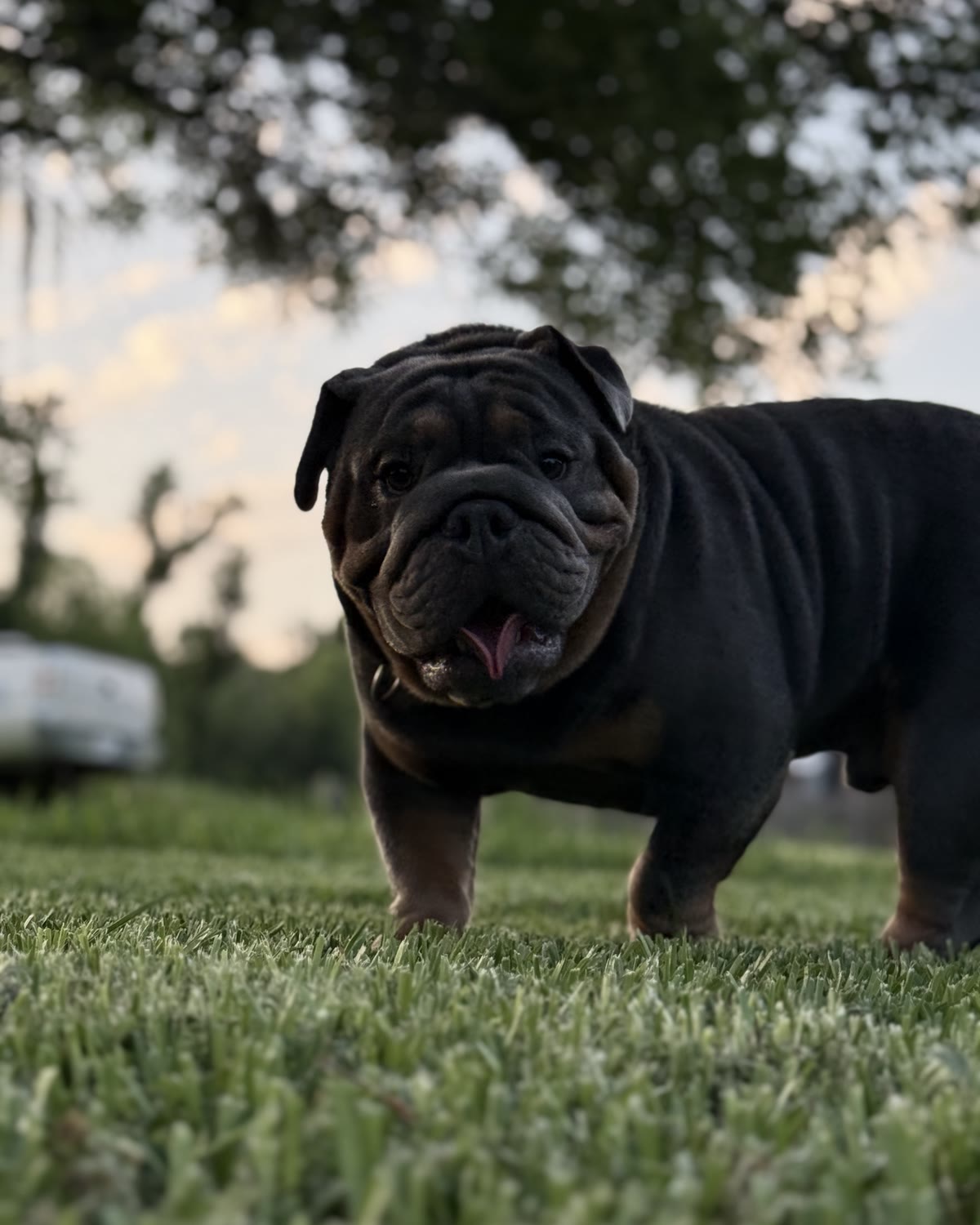
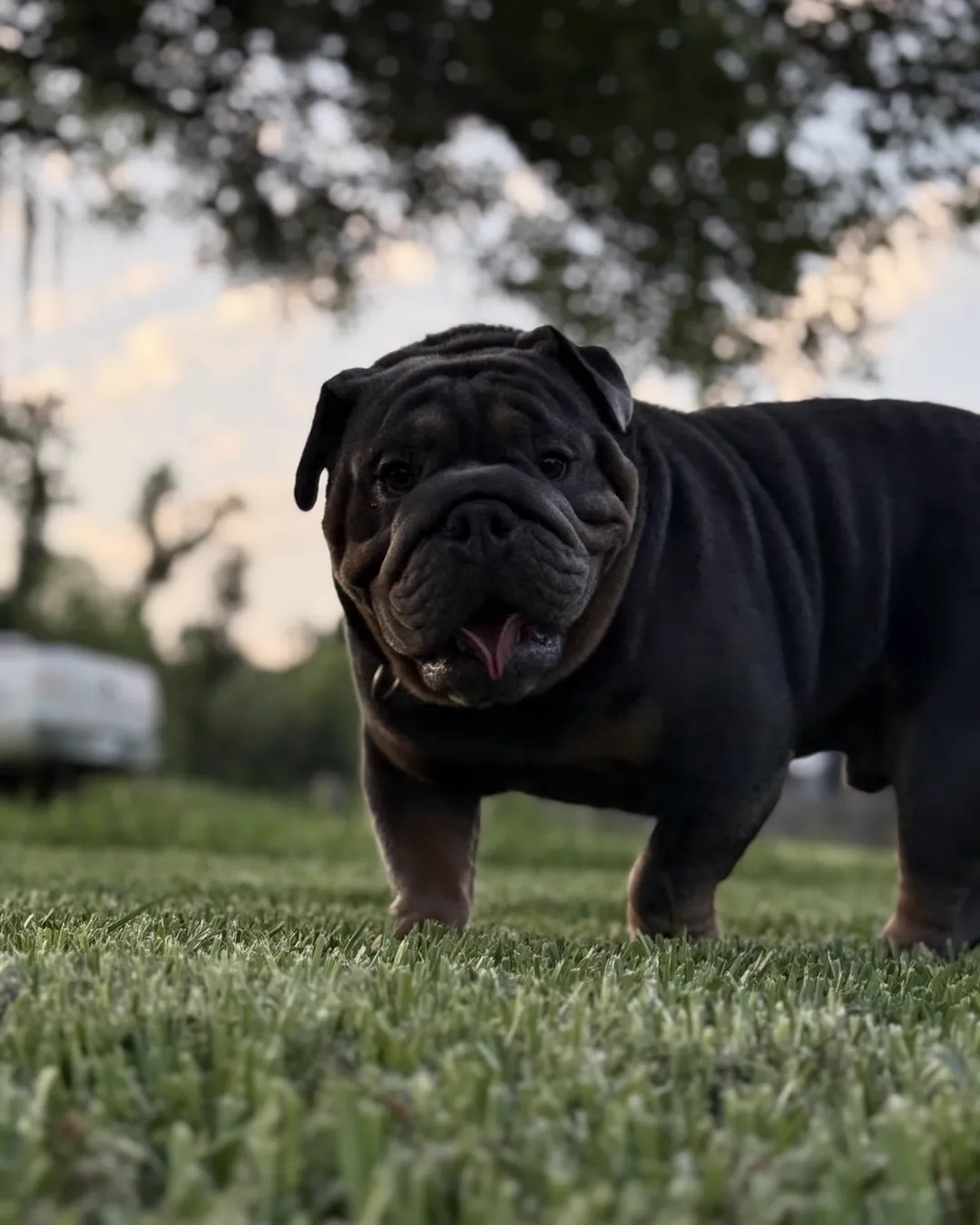
One public stud. We would rather tell you everything about one dog than a little about four.
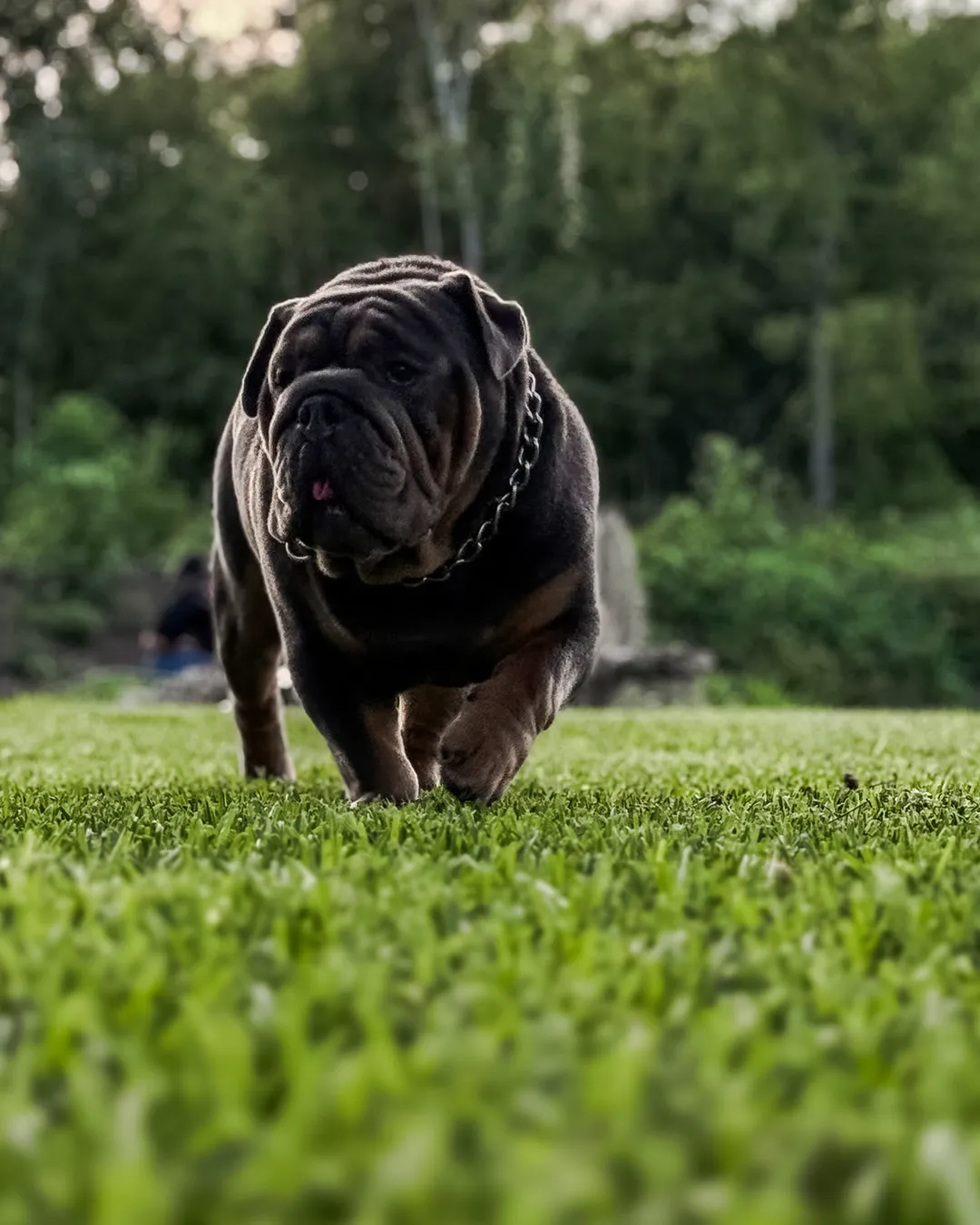
TANK is a full suit blue tri out of Chocolate Thunder and PHAT MA, born June 19, 2025. He is a first-generation Godspeed male, the keeper off the first litter this kennel ever produced. He stands public at stud at two years old. Ask us where he is on that calendar when you message.
In plain words, his pedigree runs two directions. Through his sire, Chocolate Thunder, he carries Posherbulls. Through his dam’s sire, Chopper of The Bully Village, he carries a UK Kennel Club line. We kept him because his presence, his personality, and that pedigree together were what we wanted to carry forward, and we look at his structure, movement, and temperament as one piece when we think about which females he may complement.
We do not publish test results on this page, and we will not claim any here. Ask us what records exist and we will show you the papers.
03
Why Timing Is Everything
Most stud breedings that fail did not fail because of the dogs. They failed because somebody guessed the day.
A heat cycle averages two to three weeks, and VCA puts the best breeding window for most females between the tenth and fourteenth day [1]. That is the average, and the average is the problem. Some females ovulate as early as the third or fourth day and some as late as the eighteenth [1]. If you breed on day twelve because a chart said so, you can miss her by a week in either direction.
What your reproductive veterinarian actually measures
The hormone that drives the whole cycle is luteinizing hormone, LH. Merck calls the LH surge the central event of the female’s reproductive cycle: it triggers ovulation, and the eggs are released two to three days after the LH peak [2]. Progesterone begins to rise at about the same time as the LH surge, which is why a progesterone blood test can find the surge without having to catch it on the one day it happens [2]. VCA notes some females need several progesterone tests over a series of days to predict ovulation, and that some veterinarians use a daily LH test instead [1]. Your veterinarian picks the test, runs the series, and tells you the day. We do not read numbers over the phone, and we do not publish thresholds.
The eggs are not ready the moment they are released. Merck describes them maturing for two to three days after ovulation, then staying fertile for two to three days [2]. Fresh semen, on the other hand, can live in the female for nine days or more [2]. That mismatch is why a natural or fresh-semen breeding has some slack in it, and why chilled and frozen semen do not. Merck counts the breeding days from the first progesterone rise and gives a tighter window the further the semen is from fresh [2].
| Semen | Merck’s window | Why it is that tight |
|---|---|---|
| Fresh (natural or fresh AI) | Between day 3 and day 6 [2] | Fresh semen can live in the female for 9+ days [2], so an early breeding still covers the fertile eggs |
| Chilled, shipped with extender | Days 4 and 6, or days 3 and 5 [2] | Chilled semen is good for later or distant use within 48 hours [2]; the days chosen depend on overnight shipping and everyone’s schedules [2] |
| Frozen | Day 5 or day 6 [2] | Thawed semen has the least time to work, so it goes in when the eggs are ripe, not before |
Two breedings are the norm. Merck advises two [2], and VCA says it is normal to arrange two matings, often 24 to 48 hours apart [1]. VCA also points out that progesterone testing is most useful for females with a history of unsuccessful matings or females who will be traveling a considerable distance [1]. If you are shipping to TANK or driving to Louisiana, that is you.
The same test sets her due date
Here is the part that matters twice for a Bulldog. Cornell puts a dog’s pregnancy at about 63 days from ovulation [3]. Count from the first breeding instead and the range opens to 63 plus or minus 7 days, because sperm survive for days in the female and the egg must mature for two to three days before it can be fertilized [3]. If the ovulation date is known, Cornell says the due date can be predicted with much more precision [3]. Bulldog litters are usually delivered by planned C-section, and ours are timed with our veterinarian from progesterone testing. The same blood work that puts the breeding on the right day puts the surgery on the right day nine weeks later.
Your veterinarian decides
Your reproductive veterinarian runs the timing.
Which test, how many draws, how far apart, and what the numbers mean for your female are decisions your veterinarian makes from her blood work. We will coordinate the collection or the shipment around the day they give you. We will not second-guess it, and we will not set a day from a calendar.
04
The Three Ways to Breed to TANK
In person, fresh chilled shipped, or frozen. Each one is a collection at a veterinary clinic and an insemination at a veterinary clinic. The difference is where the two clinics are.
We ship nationwide. Merck describes semen being diluted with an extender and chilled for later or distant use within 48 hours, with the breeding days chosen around overnight shipping and the schedules of everyone involved [2]. Frozen semen takes the distance and the calendar out of it entirely, at the cost of the tightest window of the three. Which route fits depends on where you are, when she cycles, and what your veterinarian is set up to do.
| In person | Fresh chilled, shipped | Frozen | |
|---|---|---|---|
| What it involves | Your female comes to Louisiana. TANK is collected at a veterinary clinic and she is inseminated there, fresh. | TANK is collected at a clinic here, the semen is extended and chilled, and it ships overnight to your veterinarian for insemination [2]. | TANK’s semen is collected and frozen ahead of time, stored, and shipped to your veterinarian, who thaws and inseminates on the day they set. |
| You arrange | Her progesterone series with your veterinarian, travel, and lodging. She travels cool and rested. | Her progesterone series, a receiving veterinarian who handles chilled semen, and the shipping address and contact. | Her progesterone series and a veterinarian equipped to thaw and inseminate frozen semen. |
| We arrange | The clinic appointment for collection and insemination on the day your veterinarian names. | The collection appointment and the shipment, timed so it lands on the day your veterinarian names. | The collection, freezing, storage, and shipment to your veterinarian. |
| Breeding window | Fresh: between day 3 and day 6 from the progesterone rise [2]. | Days 4 and 6, or 3 and 5 [2]. The semen is good within 48 hours of collection [2]. | Day 5 or 6 [2]. The tightest window of the three. |
| It depends on | Distance, the season, and whether she travels well. See the heat warning below. | Overnight shipping to your address and your veterinarian’s schedule lining up with hers [2]. | Your veterinarian’s equipment and whether a frozen collection has been done ahead of her cycle. |
Merck describes semen being placed in the cranial vagina with an insemination pipette, or into the uterus by transcervical catheterization, and notes that surgical access to the uterus is less desirable because it is invasive and needs anesthesia [2]. Which route your female gets is a clinical call for the veterinarian doing the insemination, based on the semen type and on her. We do not describe technique on this page because a breeder with a description is not a veterinarian with a catheter.
Safety
Merle to merle, never. Bulldogs and heat, never.
Two lines we do not cross. First: we never pair merle to merle, which the Breed page already states, and a stud fee does not change it. TANK is listed as a full suit blue tri. If your female is merle, say so when you inquire, and we will tell you plainly whether the pairing is one we will do. Second: an English Bulldog does not handle heat, and a Louisiana summer is as hot and wet as it gets. A female driven or flown here in June, July, or August is at risk from the moment she leaves the air conditioning. If she comes in person, she travels in the cool of the morning, in a running vehicle with the air on, never left in a parked car for any length of time, with water and stops. If the heat makes that a bad idea, ship the semen instead of the dog. We would rather lose a booking than see a Bulldog overheat in a parking lot.
05
The Timeline, Inquiry to Breeding
Seven steps. Most of the time between them is waiting on her body, not on us.
From first message to breeding day
- Message us with her heat date. Use the form on TANK’s page or call or text. Name, phone, email, her first day of heat or the expected one, the breeding day you are planning for, and whether you want in person, shipped, or frozen.
- We talk pedigrees. You send her papers, we walk TANK’s full pedigree with you, and we talk through the whole pairing. If it is not a pairing we would make, we say so here, before any money moves.
- Lock-in. Once the timing is confirmed with you, a lock-in secures the date and is applied to the fee. Nothing is charged before that. The fee, the lock-in, and the terms are confirmed in writing before the breeding.
- Progesterone with your veterinarian. Her series starts early in the heat and runs until your veterinarian names the day. You send us that day the moment you have it.
- Collection or shipment scheduled. We book TANK’s collection at the clinic to land on the day your veterinarian named, or, for frozen, confirm the shipment to your veterinarian ahead of her window.
- Breeding. One or two inseminations at the clinic on the days your veterinarian set. Two is the norm [1][2].
- Confirmation. Your veterinarian confirms the pregnancy on her timeline. Tell us either way. We want to know, and it is how we plan the next one.
How long does all that take? From first message to breeding is usually one heat cycle, sometimes two if she is between heats when you write. VCA puts the interval between heats at four to twelve months, with an average of seven [1], so a female who just finished a cycle may be most of a year from the next one. Message early. The pedigree conversation can happen any time; the collection cannot.
06
What the Fee Covers and What It Does Not
The numbers are already on TANK’s page. Here they are again, with the parts a page of numbers leaves out.
Text us for the stud fee. A lock-in secures your date once we have confirmed timing with you, and it is applied to the fee. Nothing is charged when you send the inquiry form. Availability and the written terms are discussed before any reservation.
- The fee and lock-in are shared by text. What the fee covers beyond the breeding itself, and what it does not, is put in writing before the breeding.
- Your female’s own veterinary work, her progesterone series, her exam, and anything her veterinarian does for her, is between you and your veterinarian.
- Travel, lodging, and the receiving clinic’s fees at your end are yours.
Note
Return service.
If your female does not conceive, or whelps two or fewer live puppies, you get one return service to the same female at her next heat with no additional stud fee. Tell us in writing as soon as the miss or the count is confirmed, within the notice window in your agreement, and have her veterinarian document it. Collection, shipping, and the veterinary work at your end are yours both times. Stud fees are not refunded. If the return service also misses, the agreement is complete. The fee, the lock-in, and these terms are confirmed in writing before the breeding.
Your veterinarian decides
No outcome is promised.
Nobody can promise a pregnancy, a litter size, a color, or a pattern from any pairing, and we do not. Timing, the female’s cycle, her health, and the receiving veterinarian’s work all sit outside our hands. What we promise is the part we control: an honest pairing conversation, a collection on the right day, and straight answers before and after.
07
What We Ask of the Female and Her Owner
TANK is half of this. We hold the other half to the same standard we hold him to.
- Maturity. A female who is fully grown and settled, not on her first heat. Your veterinarian is the one who says she is ready to carry a litter, and we take their word over ours.
- Condition. Fit, not fat. A Bulldog carrying extra weight is harder to breed and harder to deliver.
- Her own veterinary clearance. A pre-breeding exam from her veterinarian, and a reproductive veterinarian lined up to run her timing. We will ask who it is.
- Her papers. Registration and a pedigree we can read. If her registration is limited, tell us; it changes what can be done with the puppies.
- Honesty about prior litters. How many, how delivered, how she recovered, what went wrong if anything did. We will not judge a hard history, but we will not work around a hidden one.
- No merle to merle. If she is merle, say so in the first message.
- A plan for the puppies. We care where TANK’s puppies end up. Tell us how you place yours.
We may ask to see her, in person or on video, before we agree to the pairing. That is not an inspection. It is the same look we give our own dogs before we decide anything, and it is the only way we can honestly say we considered the whole pairing.

08
After the Breeding
The collection is our part. From here the work is hers, yours, and your veterinarian’s. We stay on the phone.
Your veterinarian confirms the pregnancy, usually by ultrasound, on the schedule they set for her. Let us know the result either way. If she took, we want the date. If she did not, we want to know that too, because it tells us something about the timing, the shipment, or the pairing that we will use next time.
Because the breeding was timed from her progesterone series, you already have the one number that matters for the next nine weeks: her ovulation date. Cornell puts the pregnancy at about 63 days from ovulation [3], and a Bulldog C-section gets planned from that date with her veterinarian. We wrote two guides for what comes next.
- Pregnancy and Whelping: late term, the planned C-section, and recovery
- Newborn Puppy Care: the first eight weeks, with temperatures, weights, and red flags cited
And when the puppies are on the ground, send pictures. They go in the space on this page that is waiting for them.
09
Questions We Get
Does TANK breed naturally?
No. Collection is done at a veterinary clinic and so is the insemination, whether your female is here in person or the semen ships to her veterinarian. There is no natural cover.
How do I know which day to breed?
You do not guess it. Your reproductive veterinarian runs a progesterone series, or a daily LH test, across her heat and names the day [1][2]. The best window for most females is around days ten to fourteen, but ovulation can come as early as day three or four or as late as day eighteen [1], which is why the blood work exists. Send us the day they give you.
Can you ship to my state?
Yes. Fresh chilled semen ships nationwide to your veterinarian. Merck describes extended, chilled semen as usable within 48 hours, with the days chosen around overnight shipping and everyone’s schedules [2]. Frozen semen ships too, and takes the calendar out of it. Your veterinarian has to be set up to receive and inseminate with the type you choose.
What if she does not take?
It happens, and it is not always anyone’s fault. Tell us. What we do about it is covered in the return-service terms, which are confirmed in writing before the breeding along with the fee and the lock-in. No pregnancy is promised.
Can I see TANK before I decide?
Yes. Visit the kennel in Houma, or ask for video. We will walk his full pedigree with you and show you whatever records exist. We would rather you see the dog than take our word for him.
References
Numbers in brackets point here. Each page was read on the date shown and the figures on this guide were checked against it. Where two sources differ, both are given.
- [1]VCA Animal Hospitals. Breeding for Pet Owners: Estrus and Mating in Dogs. https://vcahospitals.com/know-your-pet/breeding-for-pet-owners-estrus-and-mating-in-dogs Accessed 2026-10-18
- [2]Merck Veterinary Manual. Breeding Management of Bitches. https://www.merckvetmanual.com/management-and-nutrition/management-of-reproduction-dogs-and-cats/breeding-management-of-bitches Accessed 2026-10-18
- [3]Cornell University College of Veterinary Medicine, Riney Canine Health Center. The normal whelping process. https://www.vet.cornell.edu/departments-centers-and-institutes/riney-canine-health-center/canine-health-information/normal-whelping-process Accessed 2026-10-18
Educational only, not veterinary advice. Godspeed Bulldogs is a breeding kennel, not a veterinary practice. Nothing on this page replaces the judgment of a licensed veterinarian who has examined your dog. Talk to your veterinarian before using any medication, supplement, fluid, feeding technique, or schedule described here.