ResourcesNewborn Puppy Care
- Written for
- New breeders with a litter due, and families who want to know what their puppy went through before it came home.
- Last reviewed
- 2026-10-18
- Status
- Owner reviewed, veterinary review pending
01
Before They Arrive
Every piece of equipment is in the room, tested, and clean before the C-section is scheduled.
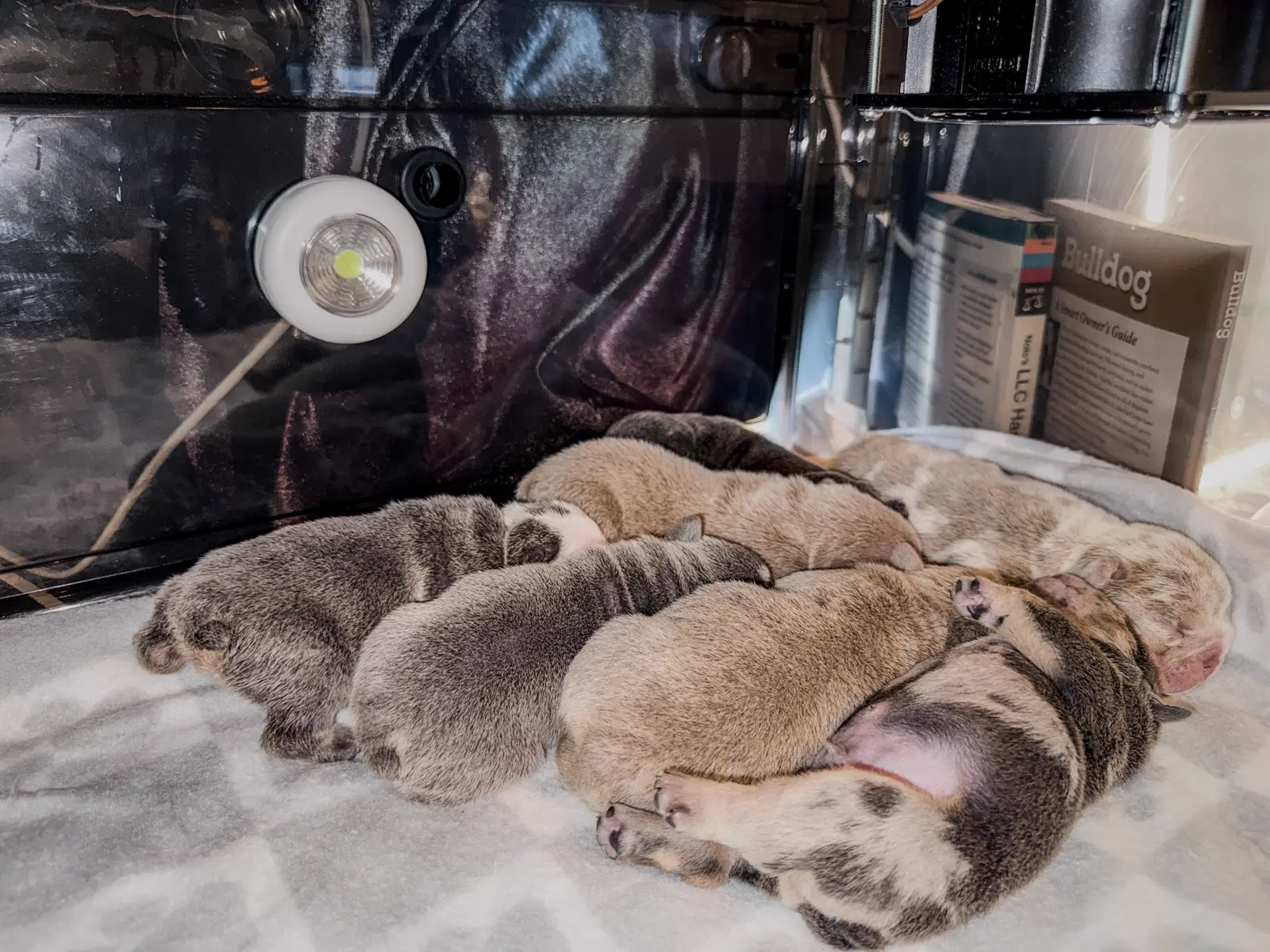
English Bulldog litters at Godspeed are delivered by planned cesarean, timed with our veterinarian from progesterone testing. A planned C-section gives us a date, so the room is ready days ahead. The whelping room is set up and the dam has been sleeping in it for days before the surgery.
What is in the room before the litter
- A controlled warm space for the puppies, with a way to keep humidity up, running for a full day before the puppies arrive so you know it holds its numbers
- A separate digital thermometer and hygrometer at puppy level, because a unit’s own readout is not the same as the air the puppies are breathing
- A whelping box with rails along the inside walls so a puppy has somewhere to go when the dam leans back
- A digital scale that reads in grams, and a printed weight log with one column per puppy
- A digital rectal thermometer for the puppies and one for the dam
- Clean towels and bedding, far more than seems reasonable, plus absorbent pads and unscented wipes
- Your veterinarian’s number and the nearest 24-hour emergency hospital written on the wall, not saved in a phone
Note
Ask before the litter, not after.
Before the surgery date, ask your veterinarian what they want you to have on hand, what they will prescribe for the dam’s recovery, and what they want you to do the moment a puppy looks wrong. Write the answers down. The night you need them is not the night to call around.
02
The First 24 Hours
The dam is coming out of anesthesia. The puppies need to nurse.
Full recovery from anesthesia can take anywhere from two to twelve hours [5]. Until the dam is fully awake, standing, and clearly interested in her puppies, she is never left alone with them. A groggy mother can roll onto a puppy and not know it.
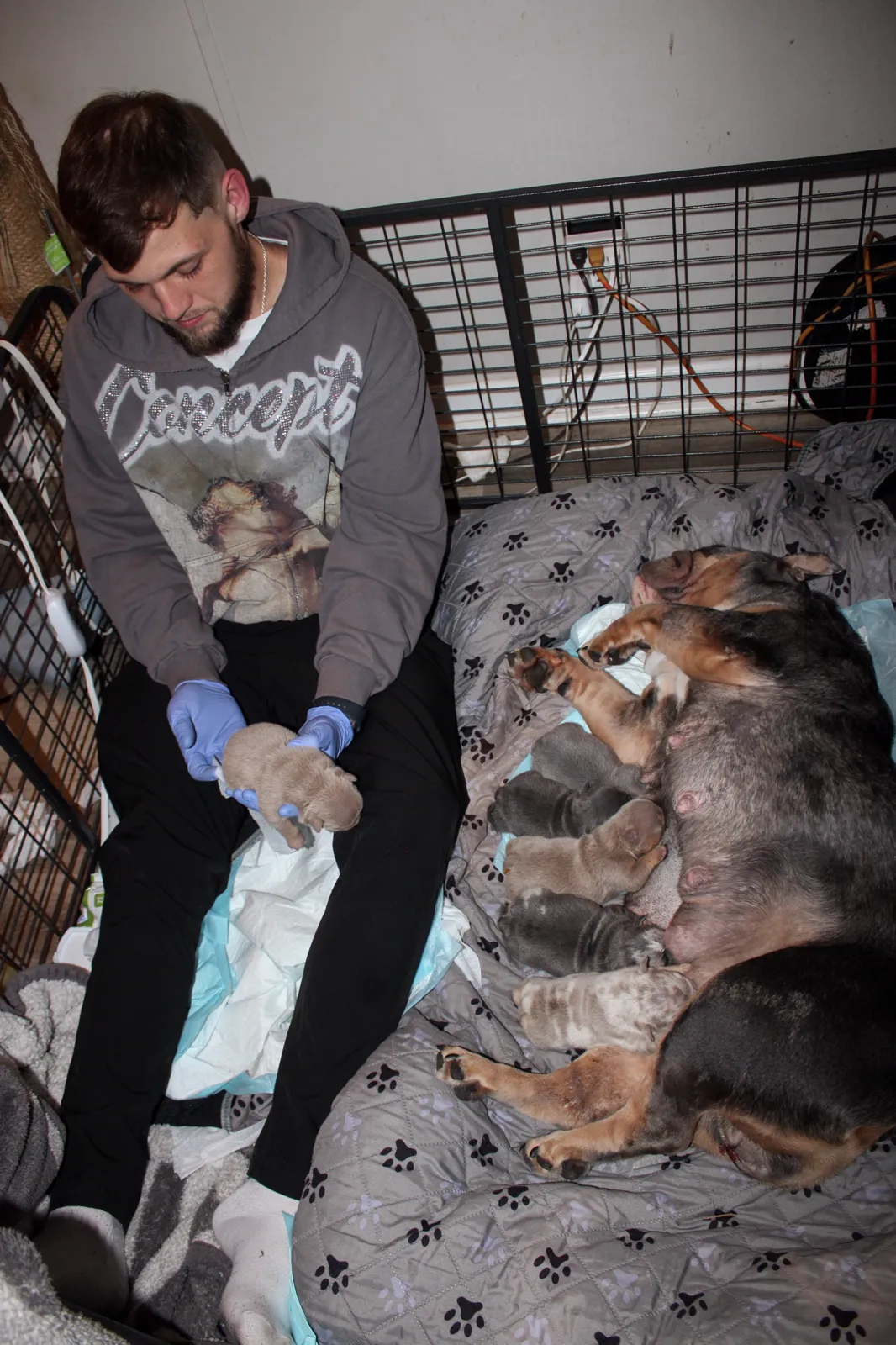
Nursing still has to happen. Every puppy’s mouth is checked for a cleft palate before it nurses. While she recovers, nursing is supervised, with the puppies put on and taken off by hand, as often as every one to two hours [1]. The breeder holds the puppy to the teat, watches it latch, and moves it to another teat when it slows. Puppies that drift to the edge of the group get brought back to the middle.
Colostrum: the first 24 hours
The dam’s first milk carries the antibodies a newborn cannot make for itself. The window to absorb them is short: intestinal absorption generally stops by about 24 hours after birth [1]. That is why the first day is not a day to let a puppy sleep through feedings. Every puppy nurses, and the small ones nurse first.
Birth weights and identification
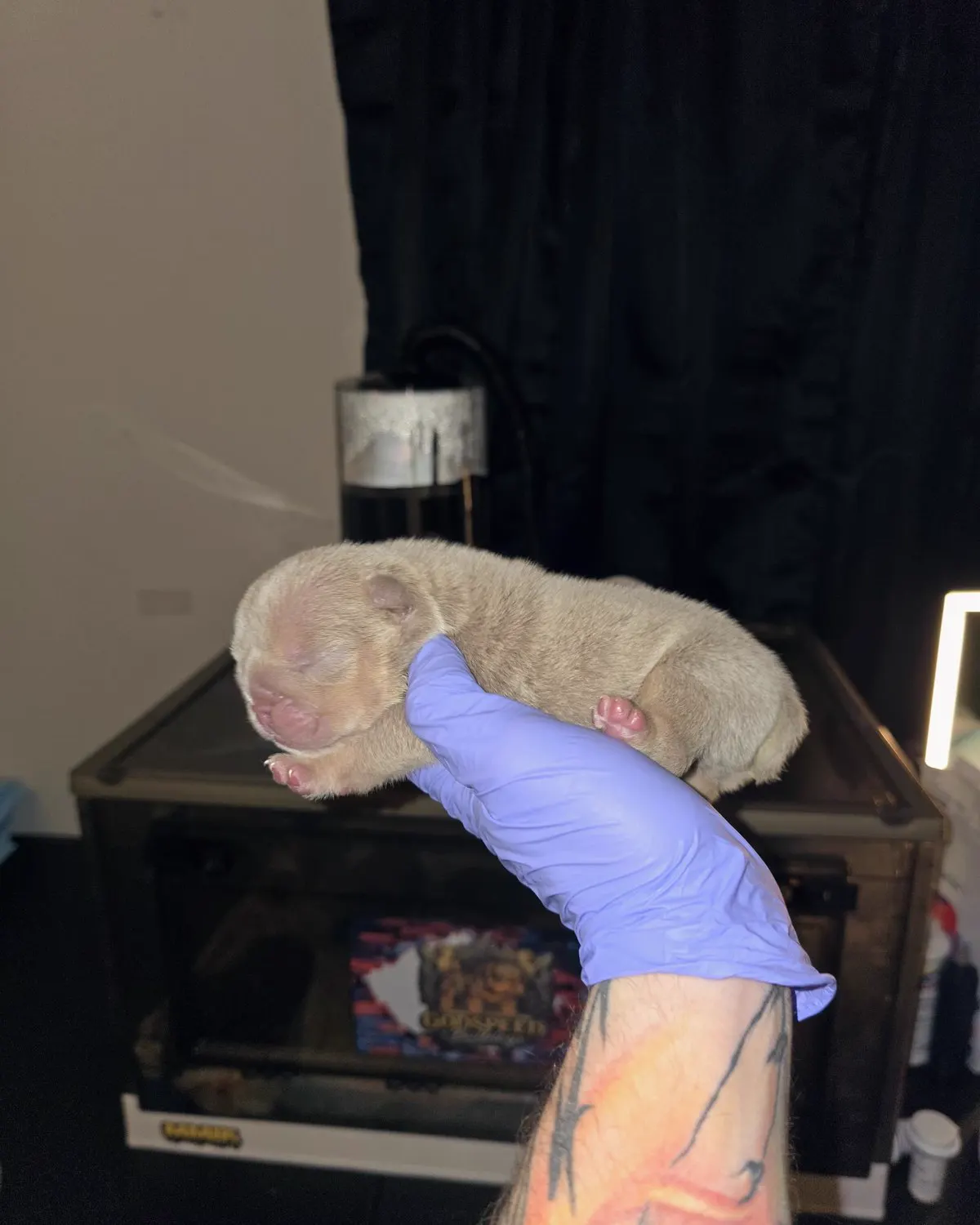
Each puppy is weighed in grams and written down before anything else happens. That number is the baseline every later weight is judged against. Each puppy gets a marker that stays put so the log stays honest; in a litter of similar coats, a mistaken identity in the log hides a puppy that is losing weight.
Note
Umbilical cords, early exams, and anything under the skin.
Cord care, the newborn exam, and any injection or fluid are set by your veterinarian. Ask for an exam of the dam and all puppies within the first two days [3]. Injections, fluids, and oxygen are clinical decisions, not whelping-room routine.
03
Warmth, by the Numbers
Puppies cannot regulate their own temperature until about four weeks of age [1]. Until then, the environment does it for them, and you measure the environment.
Merck and VCA give slightly different ranges; both are shown. The Merck table is a general environmental-warmth guide. The VCA figures are for the air over the whelping box, with the note that a larger litter huddles and can tolerate the lower end.
| Age | Merck Veterinary Manual | VCA Animal Hospitals |
|---|---|---|
| Days 1 to 4 | 84 to 89°F (28.9 to 31.7°C), week 1 | 85 to 90°F (29.5 to 32°C) |
| Days 7 to 10 | Lower gradually to about 80°F (26.7°C) | |
| Weeks 2 to 3 | 80°F (26.7°C) | |
| Week 4 | 69 to 75°F (20.6 to 23.9°C) | About 72°F (22.2°C) by the end of week 4 |
| Week 5 | 69°F (20.6°C) |
Humidity matters as much as heat. Dry heat dries the airway. Merck recommends 55 to 65 percent relative humidity [1]. VCA gives the same range for a healthy newborn and a higher range for a small or weak puppy, with a clear ceiling: do not run high heat and high humidity together, because 95°F with 95 percent humidity can make breathing difficult [4].
| Age | Rectal temperature |
|---|---|
| Week 1 | 95 to 99°F (35 to 37.2°C) |
| Weeks 2 to 3 | 97 to 100°F (36.1 to 37.8°C) |
| Week 4 | 99 to 101°F (37.2 to 38.3°C) |
Safety
Below 94°F is an emergency. Warm slowly.
A puppy with a body temperature under 94°F (34.3°C) is in a life-threatening state [4]. Rewarm it gradually over 30 to 60 minutes [1][4]. Fast rewarming is its own danger. Heat should never touch the puppy directly: Merck notes heating pads can burn neonates that cannot crawl away [1]. Use an overhead source at a safe distance or a controlled incubator, and leave a cooler zone the puppies can move to.
Warm, fed puppies are quiet and gaining. Crying, scattered puppies are too cold, too hot, or hungry [3].

04
Feeding and Weight
A newborn should nurse and sleep at least 90 percent of the time in the first two weeks [3].
Weigh daily
Merck has puppies weighed daily for the first two weeks, then every three days to one month [1]. We weigh at the same times each day and write it down against the birth weight. A loss of up to about 10 percent of birth weight on day one is acceptable [1]. After that, the line should go up. Normal gain is on the order of 5 to 10 percent of body weight per day [1].
Any weight loss after day one, or a puppy that holds steady while its littermates climb, is a prompt veterinary exam, not a wait-and-see [3].
When nursing is not enough
Some puppies cannot keep up. Restless puppies without a full belly may need supplemental feeding, and your veterinarian can supply the formula and feeder and tell you how much and how often [3]. Formula is a canine milk replacer, never cow’s or goat’s milk [4]. Warm it to about 95 to 100°F and test a few drops on the inside of your forearm; it should feel like skin or barely warmer [4]. Feed with the puppy’s head level, never tipped back, because a newborn does not gag reliably and fluid in the lungs can go unnoticed [4].
Your veterinarian decides
Tube feeding is taught in person.
Passing a tube to a puppy’s stomach is fast and effective in trained hands and dangerous in untrained ones. Your veterinarian shows you the technique, the volumes, and the schedule for your puppy [4]. We do not publish volumes, and we will not teach it over the phone. It is also delayed until the puppy is warm [1].
Elimination
A newborn cannot pass urine or stool on its own. The dam does it by licking. When she is recovering from surgery or has a puppy she is not attending to, you do it: after each feeding, a warm damp cloth or cotton ball rubbed gently over the genital area, for the first two weeks [4]. Skipping it can cause constipation or a ruptured bladder [4]. Normal stool is soft but not watery.
05
How to Read a Puppy
A healthy newborn squirms and complains when you pick it up, then nurses and sleeps quietly [1].
| What you see | What it may mean | What to do |
|---|---|---|
| Weight loss after day one, or no gain for 24 hours | Not getting enough milk, chilled, or an early infection [1][3] | Check temperature, check the latch, call your veterinarian the same day |
| Cold to the touch, limp, slow to respond | Hypothermia, which also shuts down digestion [1] | Warm slowly over 30 to 60 minutes. Do not feed until warm. Call your veterinarian if it does not come up |
| Constant crying, restless, scattered from the group | Underfed, too cold or too hot, or unwell [3] | Check the environment numbers and the belly. Put the puppy on a hind teat. If it continues, call |
| Milk from the nose, coughing or gurgling after feeding | A cleft palate, or fluid in the airway with a risk of aspiration [4] | Stop feeding, keep the head level, call your veterinarian now |
| Regurgitation or vomiting, swollen tight belly | Possible ileus or infection [1] | Call your veterinarian now |
| Persistent diarrhea | Listed by Merck among the signs of sepsis [1] | Call your veterinarian now |
| Blue or gray gums, labored breathing | Not enough oxygen | Emergency. Go now |
| Tacky dry gums, skin that stays tented when lifted | Dehydration [4] | Call your veterinarian. Fluids are prescribed and taught, not improvised |
| Twitching, seizures, severe lethargy | Possible low blood sugar [4] | Emergency. Your veterinarian may have told you what to put on the gums; do only that, and go |
Safety
When in doubt, it is a phone call.
Merck states it plainly: care by a veterinarian in the immediate neonatal period improves survival [1]. Call early. Puppies decline in hours.
06
The Dam After Surgery
She had abdominal surgery today.
The first days
- She should start eating within a few hours of surgery. For the first 24 hours, offer small amounts of food and water every 15 to 30 minutes rather than a full bowl, which can cause vomiting [5].
- Her temperature may rise 1 to 2°F in the first one to three days. Above 104°F (40°C), contact your veterinarian as soon as possible [5].
- Bloody discharge is normal for three to seven days, heavier at first. Have her checked if it lasts over a week, changes color, or smells bad [5]. A longer, darkening discharge over about three weeks is the normal lochia [8].
- Check the incision every day for redness, swelling, discharge, or stitches opening. Nursing puppies may irritate it. A cone is usually not used, because it endangers the puppies and stops her from cleaning them [5].
- No over-the-counter pain relievers, and no medication, supplement, or herbal product of any kind without your veterinarian’s approval. Pain relief for a nursing mother is prescribed [5].
Feeding a nursing mother
Early nursing needs about 1.5 times her pre-pregnancy intake, rising to two to three times by weeks three and four [5]. Peak lactation, at three to five weeks, can run two to four times a non-pregnant adult’s calories [9]. She eats a commercial puppy or growth food through lactation, and she is fed on a schedule rather than free-choice when the litter is small, because of mastitis risk [9].
Safety
Eclampsia is an emergency, and calcium is not a home remedy.
Eclampsia, a life-threatening drop in blood calcium, is most common when the puppies are about one to four weeks old and milk production peaks [6]. Early signs are restlessness, panting, and stiff movement. It can progress to tremors, spasms, and seizures [3]. Stop the puppies from nursing and contact a veterinarian immediately [3][6]. Calcium during pregnancy is not recommended [6]. After whelping, your vet may prescribe oral calcium for a dam at risk. Never add it on your own.
Watch the mammary glands at every nursing. Swollen, red, hot, hard, or tender glands, or milk that is yellowish or bloody, can mean mastitis, which develops quickly and is a call to your veterinarian [3]. Keeping the puppies’ nails short and the teats clean before nursing is the breeder’s part; treatment is the veterinarian’s.
07
The Second Week to the Fifth
Once she is fully recovered and clearly tending the litter on her own, nursing no longer has to be hand-supervised around the clock. The whelping box with its rails becomes her space, and she is in it with them. The weight log continues. Daily weights through two weeks, then every few days [1], and every puppy is still handled, looked at, and felt over once a day.
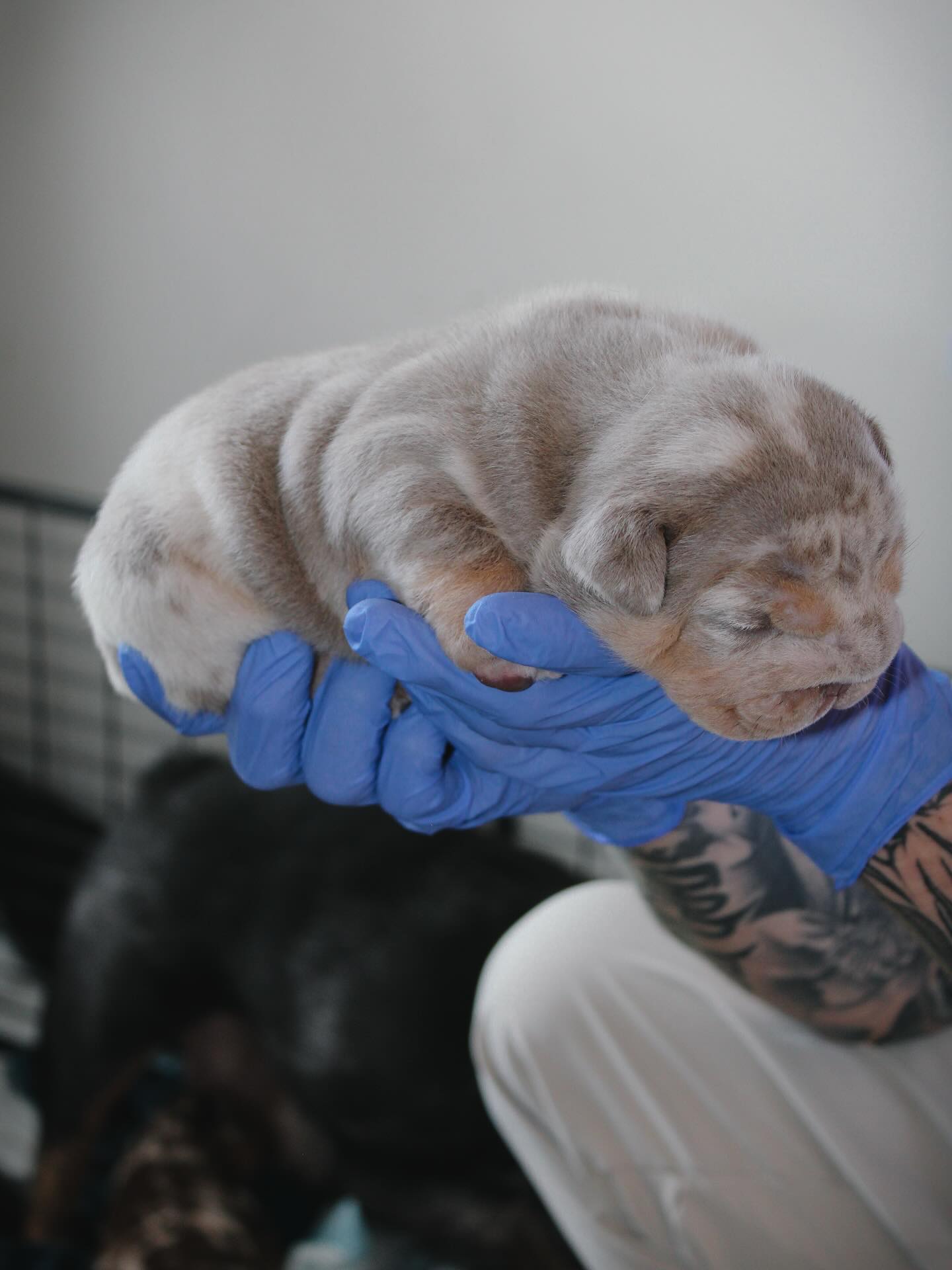
In the second week the eyes open, then the ears, and the puppies begin to crawl with purpose. By three weeks they are up on their legs and starting to interact with each other. This is when gentle daily handling starts to matter for the dog it will become: picked up, turned over, touched on the feet and ears and mouth, spoken to, and put back.
Note
Deworming and the first vaccines are your veterinarian’s schedule.
Both start earlier than most new breeders expect, and VCA notes that puppies that did not nurse on day one may need an earlier plan still [4]. Product, dates, and doses come from your veterinarian for your litter and your area. We do not publish ages or a schedule, because a copied schedule is how puppies get the wrong one.
08
Weeks 3 to 8: Weaning and Go-Home Day
The dam stays with the puppies the whole way.
Breeders quoted by the AKC start offering a thin, gruel-like mush at about three to four weeks, once the puppies show interest and the first teeth come in [7]. The mush is a puppy-formulated food that meets AAFCO growth standards, soaked thin with water or a canine milk replacer, served in a shallow dish or on a finger first [7]. Milk-based human products are too rich and upset small stomachs, and human baby cereal is not balanced for puppy growth [7].
- Weeks 3 to 4: the first thin mush is offered, nursing in between. Weights are still logged every day [7].
- Weeks 4 to 5: the mush thickens and more of the day’s food comes from the dish. Puppies move to a larger space [7].
- Weeks 5 to 6: most puppies fully on food. The AKC breeders aim for full weaning at about five to six weeks, leaving time to confirm every puppy eats and gains before placement [7].
- Weeks 6 to 8: dry puppy food, softened less each week, with the AKC breeders on dry kibble by about eight to nine weeks [7]. Socialization widens: new surfaces, household sounds, short car rides, careful visitors.
Note
Do not rush her, and do not remove her.
Weaning too fast can give the dam mastitis, and separating her from the litter to force it costs the puppies the interaction they need [7]. She leaves the puppies on her own schedule, usually by nursing less and standing to end it.
Go-home day
Godspeed puppies go home at eight weeks, and only when the individual puppy is ready. Each one leaves with AKC paperwork, its veterinary records, the food it has been eating, and a written agreement. The family has already read the first-week checklist on our Breed page and has the house set up. And every family knows the rule that matters most: if you can ever no longer keep your dog, you call us first.
09
Questions We Get
How often should newborn puppies nurse?
Merck does not set a fixed interval for healthy neonates; it says supervised nursing every one to two hours while the dam is recovering from surgery [1]. In practice a healthy newborn nurses and sleeps at least 90 percent of the time [3]. The log, not the clock, tells you whether it is enough.
Can I use a heating pad in the whelping box?
Not in contact with the puppies. Merck warns that heating pads can burn neonates that cannot move away [1]. Heat comes from above at a safe distance or from a controlled incubator, and there is always a cooler zone to crawl to.
A puppy is cold. Should I feed it to warm it up?
No. Hypothermia shuts the gut down, so milk sits, comes back up, and can be inhaled [1]. Warm the puppy slowly over 30 to 60 minutes, confirm the temperature, then feed [1][4].
Do you hand-raise every litter around the clock?
For the first stretch after a C-section, yes: nursing is supervised and assisted until the dam is fully recovered and clearly tending the litter herself. After that she does the work and we watch, weigh, and handle.
What about a schedule for deworming and shots?
Your veterinarian writes it for your litter and your area. We do not repeat ages here. Ask before the litter is due, and ask again if a puppy did not nurse on day one [4].
References
Numbers in brackets point here. Each page was read on the date shown and the figures on this guide were checked against it. Where two sources differ, both are given.
- [1]Merck Veterinary Manual. Management of the Neonate in Dogs and Cats. https://www.merckvetmanual.com/management-and-nutrition/management-of-the-neonate/management-of-the-neonate-in-dogs-and-cats Accessed 2026-10-18
- [2]Merck Veterinary Manual. Environmental Warmth Required for Neonatal Dogs and Cats (table). https://www.merckvetmanual.com/multimedia/table/environmental-warmth-required-for-neonatal-dogs-and-cats Accessed 2026-10-18
- [3]VCA Animal Hospitals. Breeding for Dog Owners: Caring for Newborn Puppies. https://vcahospitals.com/know-your-pet/breeding-for-dog-owners-caring-for-newborn-puppies Accessed 2026-10-18
- [4]VCA Animal Hospitals. Orphaned Puppy Care. https://vcahospitals.com/know-your-pet/puppy-orphaned Accessed 2026-10-18
- [5]VCA Animal Hospitals. Caesarean Sections in Dogs: Post-Operative Instructions. https://vcahospitals.com/know-your-pet/caesarean-sections-in-dogs-post-operative-instructions Accessed 2026-10-18
- [6]VCA Animal Hospitals. Eclampsia in Dogs. https://vcahospitals.com/know-your-pet/eclampsia-in-dogs Accessed 2026-10-18
- [7]American Kennel Club. Closing the Milk Bar: The Puppy Weaning Process. https://www.akc.org/expert-advice/dog-breeding/closing-milk-bar-puppy-weaning-process/ Accessed 2026-10-18
- [8]Cornell University College of Veterinary Medicine, Riney Canine Health Center. The normal whelping process. https://www.vet.cornell.edu/departments-centers-and-institutes/riney-canine-health-center/canine-health-information/normal-whelping-process Accessed 2026-10-18
- [9]VCA Animal Hospitals. Feeding the Pregnant Dog. https://vcahospitals.com/crowfoot/know-your-pet/feeding-the-pregnant-dog Accessed 2026-10-18
Educational only, not veterinary advice. Godspeed Bulldogs is a breeding kennel, not a veterinary practice. Nothing on this page replaces the judgment of a licensed veterinarian who has examined your dog. Talk to your veterinarian before using any medication, supplement, fluid, feeding technique, or schedule described here.