ResourcesPregnancy and Whelping
- Written for
- Breeders planning a first Bulldog litter, and families who want to know what the mother of their puppy went through.
- Last reviewed
- 2026-10-18
- Status
- Owner reviewed, veterinary review pending
01
Before Breeding
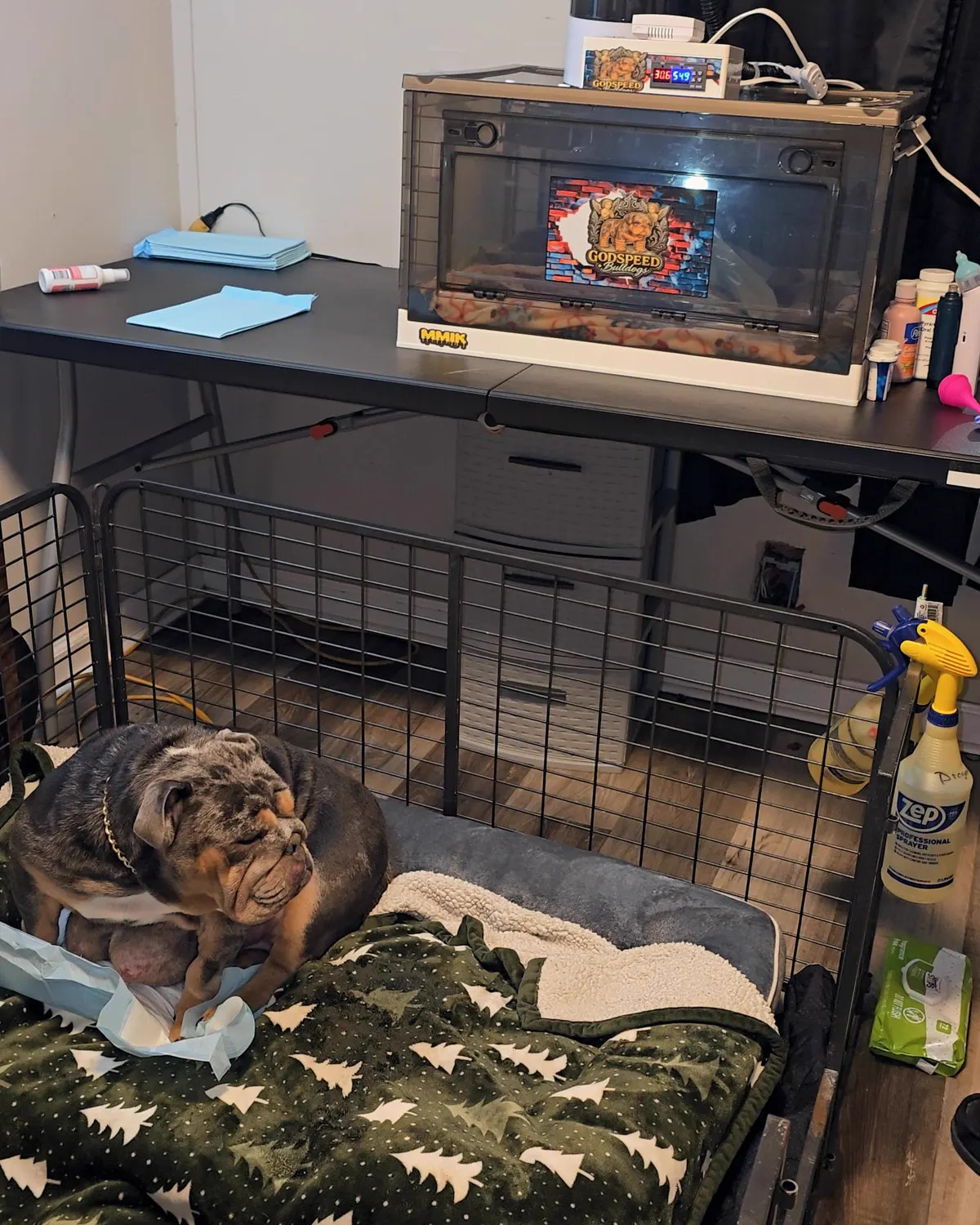
A heavy or tired dam has a harder surgery and recovery.
At Godspeed the mother comes first. A female is bred only when she is mature and in condition. We skip a heat between litters. A Bulldog that is still filling out, or that just raised a litter, is not a candidate for the next heat, and the heat is skipped.
Condition means weight, not just health
Bulldogs carry weight easily and hide it under a wide frame. VCA is direct about this: an overweight dog should lose the weight before she is bred, not during the pregnancy [9]. A dam who starts heavy is set up for a harder surgery, a harder recovery, and the obesity VCA lists among the risks of overfeeding in pregnancy [9]. A dam who starts lean and muscled has room to gain the 15 to 20 percent over breeding weight that VCA calls healthy [9].
- You can feel her ribs under a thin layer with light pressure, and you can see a waist from above.
- She walks a normal distance in the cool part of the day without laboring to breathe.
- Her heat cycles have been regular and she has had at least one cycle of rest since any previous litter.
- Your veterinarian has examined her and agrees she is a candidate for this breeding.
Note
Why we skip heats.
A female cycles whether or not she has recovered. Skipping a heat means she gets a full stretch to put weight back on, rebuild muscle, and finish being a dog before she is asked to carry again. That is what skipping a heat means in practice.
02
Timing the Breeding
When did she ovulate? Your veterinarian answers it.
Pregnancy in the dog runs about 63 days from ovulation [8]. The problem is that a breeding date is not an ovulation date. Sperm can survive for days inside the female, and the eggs take two to three days to mature after they are released, so counting 63 days from the first breeding gives a due date that can be off by a week in either direction [8]. For a breed delivered by planned surgery, a week is far too wide.
Progesterone testing closes that gap. A series of blood tests tracks the hormone rise that marks ovulation, and the due date is counted from there. Your veterinarian runs the tests and reads them. Cornell calls this the most reliable way to set a due date, and it narrows the window to about 63 days plus or minus one to two days [8]. That is the number a surgery can be scheduled against.
| What you are counting from | Expected whelping | Why |
|---|---|---|
| First breeding date only | 63 days, plus or minus about 7 days | Sperm live for days and eggs mature over 2 to 3 days, so the breeding date is a loose guess at ovulation [8] |
| Ovulation, confirmed by progesterone testing | 63 days, plus or minus 1 to 2 days | The count starts from the actual event. Cornell calls it the most reliable method [8] |
| A mid-pregnancy ultrasound | An estimate, less precise than progesterone | Useful for confirming the pregnancy and roughly estimating the date when timing was not done [8] |
Note
The tests are the veterinarian’s, and so is the reading.
We do not publish hormone values, kit names, or thresholds, and we do not run tests at home. The pattern of the rise matters as much as any single number, and reading it is a clinical skill. Ask your veterinarian when to start testing, how often to come back, and what the final result means for the surgery date.
03
Feeding the Pregnant Dam
Overfeeding early is a common mistake [9]. She looks pregnant, so she gets more food. For the first six weeks she does not need it, and it hurts her.
Through the first two trimesters a pregnant dog eats a normal adult maintenance diet in measured meals, and VCA specifically warns against overfeeding during that time [9]. The puppies are tiny and the dam’s calorie need barely moves. Weight she gains now is fat, not litter, and it rides into the surgery with her.
Around day 40 the picture changes. Fetal growth speeds up, and the dam’s needs climb with it [9]. VCA puts the peak at weeks six through eight, when she needs roughly 30 to 60 percent more than maintenance depending on how many puppies she carries [9]. That is when the food changes, the amount changes, and the meal count changes.
| Stage | What she eats | How much, how often |
|---|---|---|
| Before breeding | Her normal adult food | Enough to reach lean condition. Overweight dogs lose weight first [9] |
| Trimesters 1 and 2 (roughly weeks 1 to 6) | Adult maintenance food | Maintenance amounts in meals. Do not overfeed [9] |
| Trimester 3 (from about day 40) | A highly digestible puppy or growth food. Not large-breed puppy food [9] | Rising toward 30 to 60 percent above maintenance by weeks 6 to 8, split into several small meals [9] |
| Target gain by whelping | About 15 to 20 percent over her breeding weight [9] | |
| Nursing, peak at weeks 3 to 5 | Puppy or growth food | 2 to 4 times maintenance. Free-choice is fine for a big litter, not for one or two puppies [9] |
Note
Why not large-breed puppy food.
Large-breed growth formulas are built with a different calcium-to-phosphorus balance, and VCA notes that balance is not right for fetal bone development or for milk production [9]. A standard, highly digestible puppy or growth food is the third-trimester choice.
Late in pregnancy the puppies take up the room her stomach used to have. Several small meals a day are easier on her than two large ones [9]. Underfeeding at this stage is its own risk: VCA links it to embryo loss and low birth weights, while overfeeding is linked to obesity and difficult labor [9]. The target is the middle, and the scale tells you whether you are there.
Your veterinarian decides
No calcium, no supplements, unless the veterinarian says so.
Calcium during pregnancy is not recommended. After whelping, your vet may prescribe oral calcium for a dam at risk. Never add it on your own. Extra calcium suppresses the hormone that manages her own calcium, and that raises her risk of eclampsia later [6]. The same caution covers vitamins, powders, and anything from a breeder forum. A complete growth food already has what she needs. Your veterinarian decides whether this dog needs anything on top of it [6].
04
The Middle Weeks
Weeks three through six are quiet on purpose.
A mid-pregnancy ultrasound confirms she is carrying, gives a rough sense of the litter, and can help estimate the date when progesterone timing was not done [8]. It is not a puppy count you can bank on. It is a yes or no, and a chance for your veterinarian to look at her before the hard part.
Exercise, gentle and early
A pregnant Bulldog still walks. Muscle tone matters for the surgery and for carrying the weight that is coming. The walks get shorter and slower as she gets heavier, and they stop being walks and start being strolls around the yard by the last two weeks. No rough play with other dogs, no jumping on and off furniture, no stairs if there is a way around them.
Heat rules for a Bulldog in Louisiana
A Bulldog cannot cool itself well on a normal day. Pregnant, in a Houma summer, the margin disappears. Breeders here move every walk to first light or after dark, keep her inside with the air on through the middle of the day, and treat heavy panting at rest as a stop sign, not a quirk. Water is always within reach. If she is hot to the touch, she comes in.
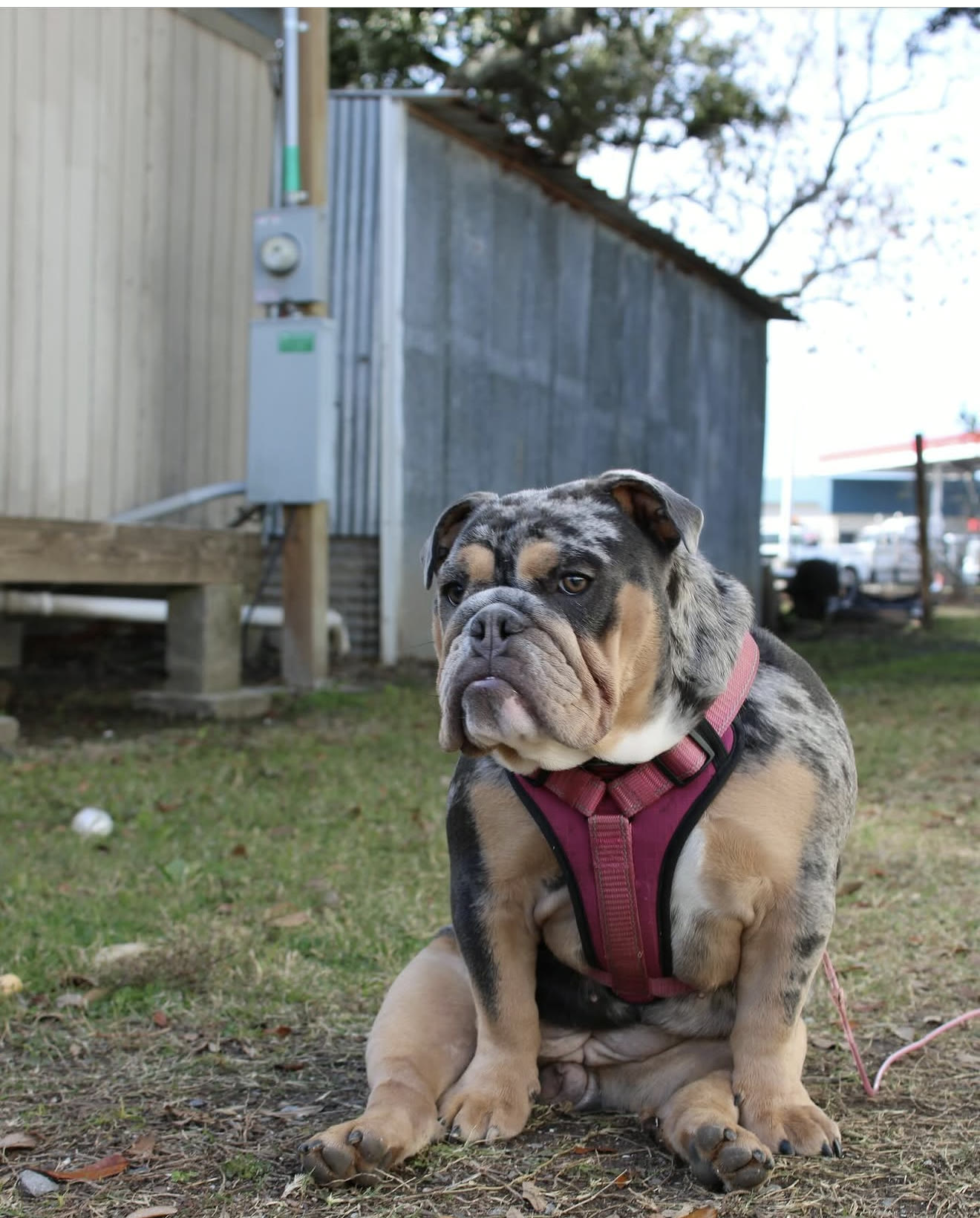
Visitors, grooming appointments, and anything stressful move to after the litter. She sleeps where she will recover, so the whelping room is hers for days before the surgery and the bed in it is already familiar.
05
The Last Week
The last week is about catching labor before it starts.
Some days before whelping she begins to nest. She digs at bedding, carries things, pushes into corners, and gets restless and clingy. Cornell lists nesting, restlessness, and panting among the signs that show up in the hours before labor, often six to twelve hours out [8]. In a Bulldog these are a cue to call the veterinarian and confirm the surgery is still on schedule, not a cue to wait and watch.
Temperature, twice a day
Starting several days before the due date, breeders take her rectal temperature morning and evening and write it down. A normal adult runs about 100 to 102.5°F [8]. Cornell describes a drop below 99°F in the 24 hours before whelping, and the drop lasts about eight hours [8]. The log matters more than any single reading. A dog whose temperature has sat in a steady band for days and then falls out of the bottom of it is telling you labor is close, and the veterinarian gets a call.
| What you see | What it usually means | What a breeder does |
|---|---|---|
| Nesting, restlessness, panting, refusing food | Labor may be 6 to 12 hours away [8] | Call the veterinarian. Confirm the surgery plan |
| Rectal temperature drops below 99°F from her usual band | Whelping is typically within 24 hours [8] | Call now. The drop lasts about eight hours, so do not wait for a second reading |
| Clear or white discharge | Normal in the hours before whelping [8] | Note it in the log. Keep watching |
| Green discharge, no puppy | A placenta has separated and a puppy should follow immediately [8] | Go to the veterinarian now |
| Her usual temperature band, calm, eating | Not yet | Keep logging. Keep the bag by the door |
The bag by the door
Packed for the veterinarian, days ahead
- The temperature log and the breeding dates, so the surgical team can see the pattern
- A warm box for the ride home: a sturdy carrier or laundry basket lined with towels, plus a safe heat source your veterinarian has approved, with a towel between it and the puppies
- A second stack of clean towels for drying puppies and for the car
- A leash and a flat collar for her, and a blanket she has already slept on
- Your phone charged, the clinic number written on paper, and the nearest emergency hospital written beside it
- Someone to drive, so the breeder can ride in the back with her and the box
06
Why a Planned C-Section
An English Bulldog puppy has a large head and wide shoulders, and the dam has a narrow pelvis and a short, heavy frame that does not push well. Labor that stalls with a puppy stuck is an emergency for both of them, and a surgery done in a hurry at night on an exhausted dog is a very different surgery from one done in the morning on a rested one.
Godspeed litters are delivered by planned cesarean. The timing is set with our veterinarian using progesterone testing, which is what gives the date its one-to-two-day precision [8]. Planned means the surgical team is expecting her, the puppies are mature, the dam has been fasted on the veterinarian’s instructions, and the whelping room at home is already warm.
What "planned" protects
- The dam. She goes under anesthesia rested and hydrated, not after hours of straining. Bulldogs have a narrow airway. Ask your vet about pre-oxygenation, fast intubation, late extubation and anti-nausea medication.
- The puppies. They are taken at term, not early because someone guessed the date, and not late because labor was allowed to run.
- The team. Surgery with a full staff on a known date is safer than surgery with whoever is on call.
Note
If labor starts early, the plan moves.
The surgery date comes from the progesterone timing, and Cornell notes that progesterone drops sharply in the day before whelping [8]. If her temperature falls or she begins nesting ahead of the scheduled day, the plan moves. That is why the last week is logged twice a day even when there is a date on the calendar.
07
Labor Warning Signs That Mean Go Now
A planned surgery is meant to make this table unnecessary. Learn it anyway. These are Cornell’s markers for when a whelping has stopped being normal [8].
Cornell describes the first stage of labor, the restless, panting, nesting stage, as lasting up to 24 to 36 hours before the first puppy [8]. In the second stage puppies usually arrive from zero to thirty minutes apart, and a gap of up to two hours can still be normal [8]. Past that, it is not. For a Bulldog, any sign in this table is a phone call and a drive, not a wait.
| What you see | What it may mean | What to do |
|---|---|---|
| Green discharge and no puppy follows right away | A placenta has separated. The puppy behind it is losing its supply [8] | Go now |
| More than two hours between puppies | Labor has stalled, or a puppy is stuck [8] | Call the veterinarian. Cornell puts the limit at two hours [8]. Expect to go in |
| Hard, steady straining with no puppy | A puppy that cannot pass | Go now. Do not pull on anything you can see |
| Stage one that drags past 24 to 36 hours with no progress | Labor is not advancing [8] | Call. Bring the temperature log |
| Temperature dropped more than a day ago and nothing has happened | The signal came and labor did not follow [8] | Call. This is the drop-and-stall pattern a planned surgery exists to prevent |
| Weakness, collapse, pale gums, or heavy bleeding | Something is wrong inside | Emergency. Go now |
| Discharge that is foul-smelling or increasing after whelping | Possible infection or retained tissue [8] | Call the veterinarian the same day |
Safety
Go early.
A dam taken to the veterinarian an hour early is checked and sent home, or delivered a little ahead of the plan. A dam taken an hour late can lose a puppy, or more. Keep the clinic number on paper, keep the car fueled, and go.
08
Recovery, the First Two Weeks
She had abdominal surgery and a litter in the same hour.
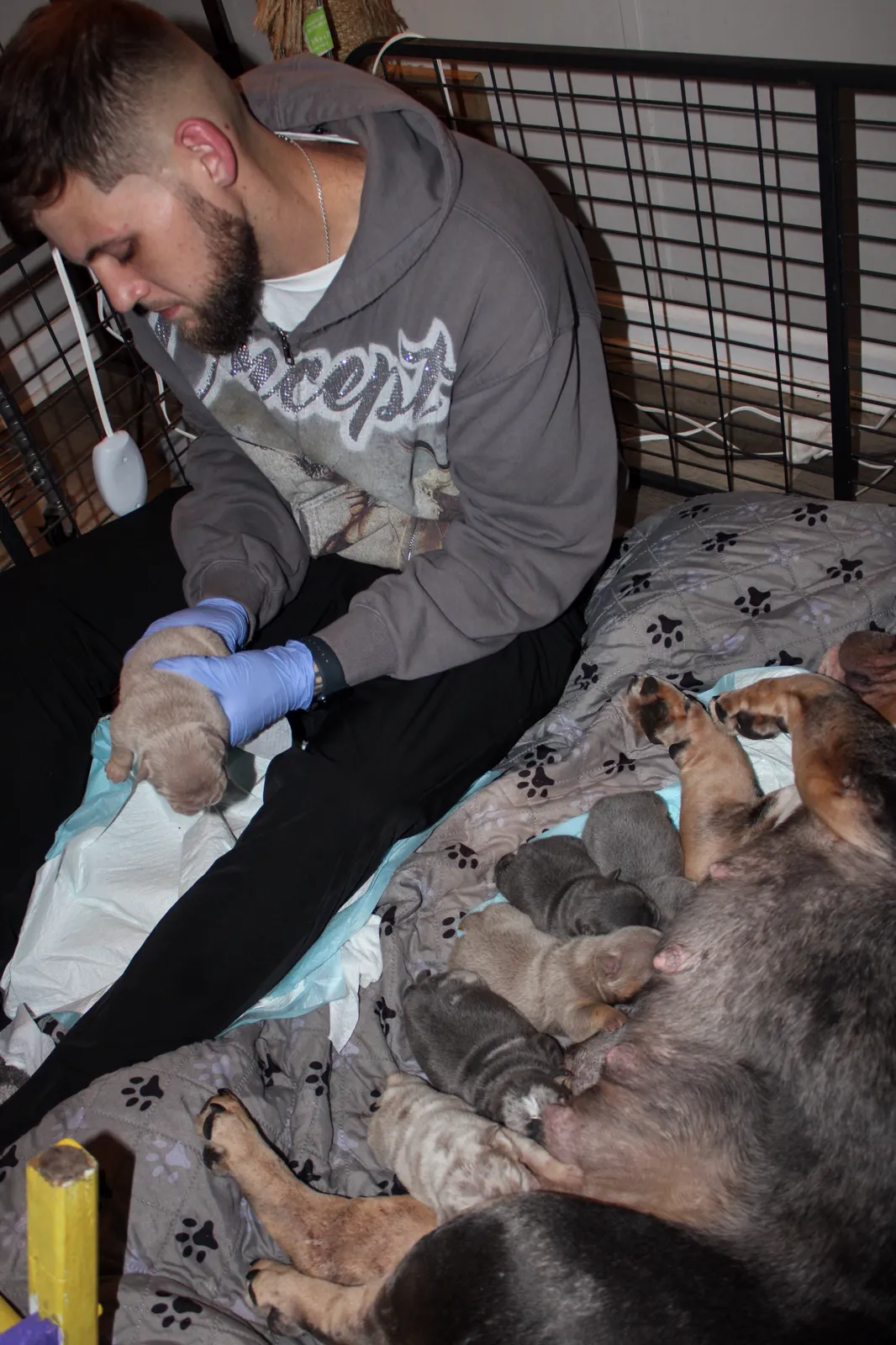
Recovery from anesthesia takes anywhere from two to twelve hours [5]. Until she is fully awake, standing steady, and clearly interested in her puppies, she is never left alone with them [5]. Nursing happens on her side, supervised, with the breeder putting puppies on and taking them off. A groggy dam can lie on a puppy without ever knowing.
The post-op checklist, from VCA
- First 24 hours: small amounts of food and water every 15 to 30 minutes, not a full bowl, which can come back up [5]
- Temperature once or twice a day. A rise of 1 to 2°F in days one to three can be normal. Above 104°F, call the veterinarian as soon as possible [5]
- Bloody discharge is normal for three to seven days. Have her seen if it lasts over a week, changes color, or smells bad [5]. A longer green to red-brown discharge over about three weeks, sometimes up to eight, is the normal lochia, and foul or increasing discharge is a call [8]
- Look at the incision every day for redness, swelling, discharge, or open stitches. Nursing puppies can rub it. A cone is usually skipped because it endangers the puppies and stops her cleaning them [5]
- Stitches or staples come out at 10 to 14 days unless your veterinarian used a kind that dissolves [5]
- Nothing by mouth that the veterinarian did not approve. No over-the-counter pain relievers, no supplements, no herbal anything [5]
- Feed her a puppy or growth food. Early nursing runs about 1.5 times her pre-pregnancy intake and rises to two to three times by weeks three and four [5]. Peak lactation at weeks three to five can reach two to four times maintenance [9]
- Meal feed rather than free-choice if the litter is one or two puppies, because of mastitis risk [9]
- Watch the mammary glands at every nursing for heat, hardness, redness, or discolored milk, and call if you see it
Safety
Eclampsia: know it before you need to.
Eclampsia is a life-threatening drop in blood calcium. It most often hits when the puppies are one to four weeks old and milk demand is highest, though it can occur before birth [6]. Early signs are restlessness, panting, and stiff or awkward movement. It can progress to tremors, muscle spasms, and convulsions [6]. If you see it, take the puppies off her and contact a veterinarian immediately [6]. Calcium supplements given during pregnancy or nursing to prevent this generally do the opposite, because excess calcium suppresses the hormone that protects her [6]. Your veterinarian decides whether she needs calcium, and when.
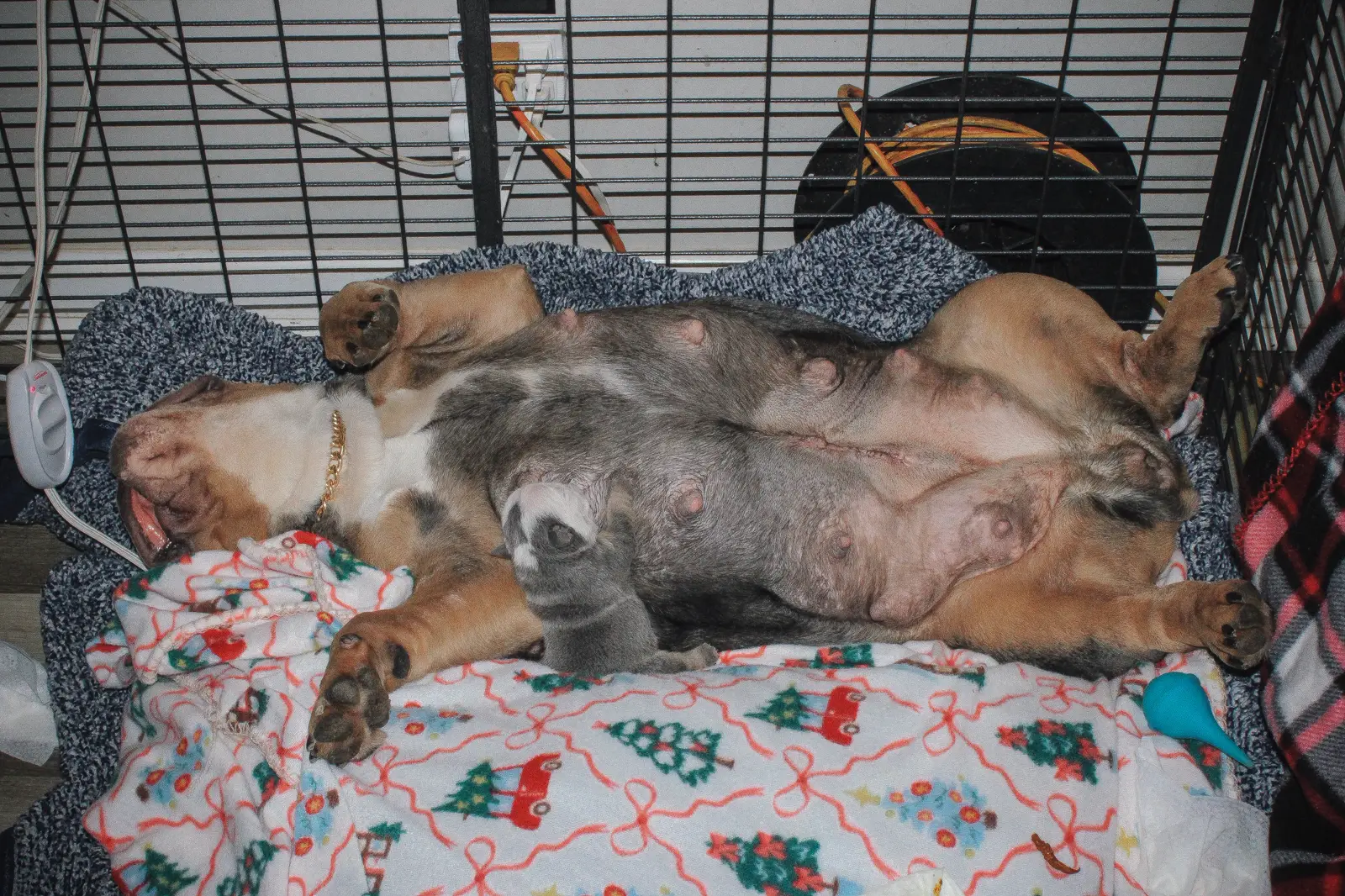
Somewhere in the second week she takes over. She cleans the puppies without being asked, moves them when they drift, and stands to end a feeding on her own terms. That is when the breeder steps back to watching, weighing, and handling. What happens with the puppies from there is on the Newborn Puppy Care page. What happens with her is simple: she does not carry again until she is fully back to the dog she was before.
09
Questions We Get
How long is an English Bulldog pregnant?
About 63 days from ovulation [8]. Counted from a breeding date it can swing a week either way, which is why the date is set from progesterone testing your veterinarian runs and reads. With ovulation confirmed, the window narrows to about one to two days [8].
Can a Bulldog give birth naturally?
Some do. The breed is built in a way that makes it a gamble, with large-headed puppies and a dam who does not push well, and a stalled labor is an emergency for both. At Godspeed every litter is delivered by planned C-section timed with our veterinarian. We do not take the chance with the mother.
Should I give her calcium or a prenatal supplement?
Not unless your veterinarian says so. Calcium during pregnancy is not recommended, because excess calcium suppresses the hormone that manages her own calcium and raises the risk of eclampsia [6]. After whelping, your vet may prescribe oral calcium for a dam at risk. Never add it on your own. A complete puppy or growth food in the third trimester covers her needs [9].
When should I switch her to puppy food, and which kind?
From about day 40, when fetal growth speeds up, move her to a highly digestible puppy or growth food and raise the amount toward 30 to 60 percent above maintenance by weeks six to eight [9]. Not a large-breed puppy formula. Its calcium and phosphorus balance is wrong for fetal bone and milk [9].
Her temperature dropped. How long do I have?
Cornell describes the drop below 99°F happening within 24 hours of whelping, and it lasts about eight hours [8]. In a Bulldog with a planned surgery, that is a call to the veterinarian right then, not a countdown you run at home. If green discharge shows up with no puppy, or straining starts, you are already driving.
References
Numbers in brackets point here. Each page was read on the date shown and the figures on this guide were checked against it. Where two sources differ, both are given.
- [5]VCA Animal Hospitals. Caesarean Sections in Dogs: Post-Operative Instructions. https://vcahospitals.com/know-your-pet/caesarean-sections-in-dogs-post-operative-instructions Accessed 2026-10-18
- [6]VCA Animal Hospitals. Eclampsia in Dogs. https://vcahospitals.com/know-your-pet/eclampsia-in-dogs Accessed 2026-10-18
- [8]Cornell University College of Veterinary Medicine, Riney Canine Health Center. The normal whelping process. https://www.vet.cornell.edu/departments-centers-and-institutes/riney-canine-health-center/canine-health-information/normal-whelping-process Accessed 2026-10-18
- [9]VCA Animal Hospitals. Feeding the Pregnant Dog. https://vcahospitals.com/crowfoot/know-your-pet/feeding-the-pregnant-dog Accessed 2026-10-18
Educational only, not veterinary advice. Godspeed Bulldogs is a breeding kennel, not a veterinary practice. Nothing on this page replaces the judgment of a licensed veterinarian who has examined your dog. Talk to your veterinarian before using any medication, supplement, fluid, feeding technique, or schedule described here.