ResourcesBulldog Nutrition
- Written for
- Families bringing a Godspeed puppy home, and anyone who owns a Bulldog and wants a plain answer about food.
- Last reviewed
- 2026-10-18
- Status
- Owner reviewed, veterinary review pending
01
Why a Bulldog’s Food Is Worth Taking Seriously
The English Bulldog is a brachycephalic breed. The short face means a narrow airway, and every pound of extra fat makes that airway work harder. The same dog is prone to skin trouble in its folds, to joint trouble on a heavy frame, and to heat trouble in a climate like ours. A Bulldog is a house dog. It cannot be out in the Louisiana heat, and it cannot cool itself the way a long-nosed dog does.
Here is the number that frames this whole page. In the 2022 Association for Pet Obesity Prevention survey, 59 percent of dogs were overweight [11]. VCA calls obesity the most common preventable disease in dogs in North America [11]. A dog is overweight at 10 to 20 percent above its ideal weight and obese above 20 percent [11]. On a Bulldog that is a handful of pounds, and it happens one treat at a time.
The cost is not cosmetic. VCA cites studies showing that being even moderately overweight can reduce life expectancy by nearly two years, and lists higher risk of osteoarthritis with faster joint degeneration, diabetes, heart disease, and anesthetic complications [11]. Anesthetic complications matter more than usual for a breed that already breathes poorly under sedation.

02
Reading a Label
The small statement on the back is the part that is regulated.
The nutritional adequacy statement
AAFCO calls the nutritional adequacy statement perhaps the most important part of a pet food label [12]. It tells you whether the food is complete and balanced, and for which life stage. Complete means the food contains all the required nutrients. Balanced means they are present in the correct ratios [12]. Most products have to carry the statement. Snacks and treats can skip it if the package says snack or treat on the front [12]. That is why a treat is never a meal.
The statement names a life stage. AAFCO lists four: gestation and lactation, growth, maintenance, and all life stages [12]. A puppy food carries growth or all life stages. An adult food usually carries maintenance. VCA’s advice for a growing puppy is to look for a statement for growth or for all life stages [10]. A food labeled only for maintenance is not a puppy food, no matter what the picture on the bag shows.
| What the label says | What it means | What to do with it |
|---|---|---|
| Formulated to meet the nutritional levels established by the AAFCO Dog Food Nutrient Profiles for a stated life stage | The recipe was built to the AAFCO nutrient profile on paper [12] | Acceptable for most dogs. Check that the life stage matches your dog |
| Animal feeding tests using AAFCO procedures substantiate that the food provides complete and balanced nutrition | The food was fed to dogs under a standardized protocol [12] | The stronger claim of the two. Still check the life stage |
| Intended for intermittent or supplemental feeding only | Does not meet the complete-and-balanced standard. Limited to non-continuous use [12] | Not a daily diet unless your veterinarian prescribed it that way |
The large-breed question
Large and giant breeds have the highest risk of growth abnormalities, so calcium gets a closer look for them, and VCA points to foods that state they meet AAFCO large-breed puppy levels [10]. Merck says the same thing from the other side: excess calcium is more of a problem for growing large- and giant-breed dogs, from weaning to about a year old [15]. An English Bulldog is not a giant breed by weight. It is a heavy-boned, fast-growing dog with a frame that pays for every mistake. Whether your puppy should be on a large-breed growth formula or a standard growth formula is a question for your veterinarian, who can see the actual dog. Ask it at the first visit.
The rest of the back panel
- Guaranteed analysis: four required numbers, minimum crude protein, minimum crude fat, maximum crude fiber, and maximum moisture [12]. It is a floor and a ceiling, not a recipe.
- Ingredient list: ingredients in descending order by weight, and the amount of each is not stated [12]. A pretty ingredient near the end of the list is in there in a small amount.
- Feeding directions: required for most complete-and-balanced foods, and they must give at least an amount of food per weight of dog for the life stage [12]. Treat them as a starting point, not a rule. The scale and your hands decide.
Note
What a Godspeed puppy comes home eating.
Our dogs eat Inukshuk Professional 32/32. It is a high-energy food, so portions are small and we weigh weekly. Buy a bag before pickup. Every puppy leaves us with a supply of the food it has been eating, and we ask the family to keep it on that food, in the same amounts, for at least two weeks before changing anything.
03
The Growth Stage, Eight Weeks to Maturity
The goal is slow, steady growth on a measured amount of a growth-stage food.
Before eight weeks
By the time a puppy comes home it has already been through weaning. Breeders quoted by the AKC start a thin mush at about three to four weeks, made from a puppy-formulated, AAFCO-tested food soaked thin, and they avoid milk-based human products and baby cereal [7]. Most puppies are fully weaned at about five to six weeks and eating dry kibble by eight to nine weeks [7]. Our puppies go home at eight weeks, so the food in the bag is the food they have been eating.
Slow is the point
VCA is blunt about fast growth: it raises the risk of skeletal deformities, obesity, and a shorter life [10]. Puppies need more calcium than adults, but too much calcium can contribute to growth abnormalities [10]. The way you control growth is not by restricting a puppy. It is by feeding a growth-stage food in measured amounts and letting the puppy grow at the rate the food and its body set.
Measured means measured. VCA’s advice is portions, two to three times a day, and no free-choice feeding [10]. Puppies reach maturity at about 10 to 12 months for small and medium breeds and 18 to 24 months for large and giant breeds [10]. A Bulldog sits awkwardly between those groups by weight, which is one more reason the switch to adult food is a call you make with your veterinarian, not from a chart.
| Age | Food | Meals | What you are watching |
|---|---|---|---|
| 3 to 6 weeks (at the kennel) | Thin mush of a puppy-formulated food, thickening weekly [7] | Several small meals, nursing in between | Every puppy eating and gaining |
| 8 weeks, go-home | The food it came home with, unchanged for at least two weeks | Measured meals, two or three a day [10] | Appetite, stool, and that it settles into the house |
| 3 to 6 months | Growth or all-life-stages food, your veterinarian’s pick on large-breed formula [10] | 2 to 3 measured meals a day [10] | Steady weight gain on a growth chart, not a jump [10] |
| 6 to 12 months | Same food, portion adjusted to body condition | 2 measured meals a day | Ribs you can feel, a waist you can see [11] |
| Maturity | Switch to a maintenance food when your veterinarian says the dog is done growing | 2 measured meals a day | Weight holds. Body condition holds |
The two-week rule
A puppy leaving its litter is already handling a new house, new people, new sounds, and no littermates. We do not add a new food on top of that. Keep the food we send home, in the same amounts, for at least two weeks. If after that you and your veterinarian want to change, do it over several days, mixing the new food into the old in increasing amounts. Loose stool during a change is a sign to slow down. If you change food and the puppy stops eating, vomits, or gets diarrhea that does not settle, that is a phone call to your veterinarian.
Feeding setup before pickup day
- The next bag of the food we send home, bought before pickup so there is no gap
- A dry measuring cup that stays with the food, or a small kitchen scale
- A written meal schedule on the refrigerator so every person in the house feeds the same amount
- A flat-bottomed, shallow bowl. A Bulldog face does not do well in a deep bowl
- A weight log, started on day one, with a weigh-in at least every week while the puppy is growing
- The puppy’s pet insurance in place from week one, before anything comes up
- Your veterinarian’s first-visit appointment booked, with the food question on the list
Treats and extras
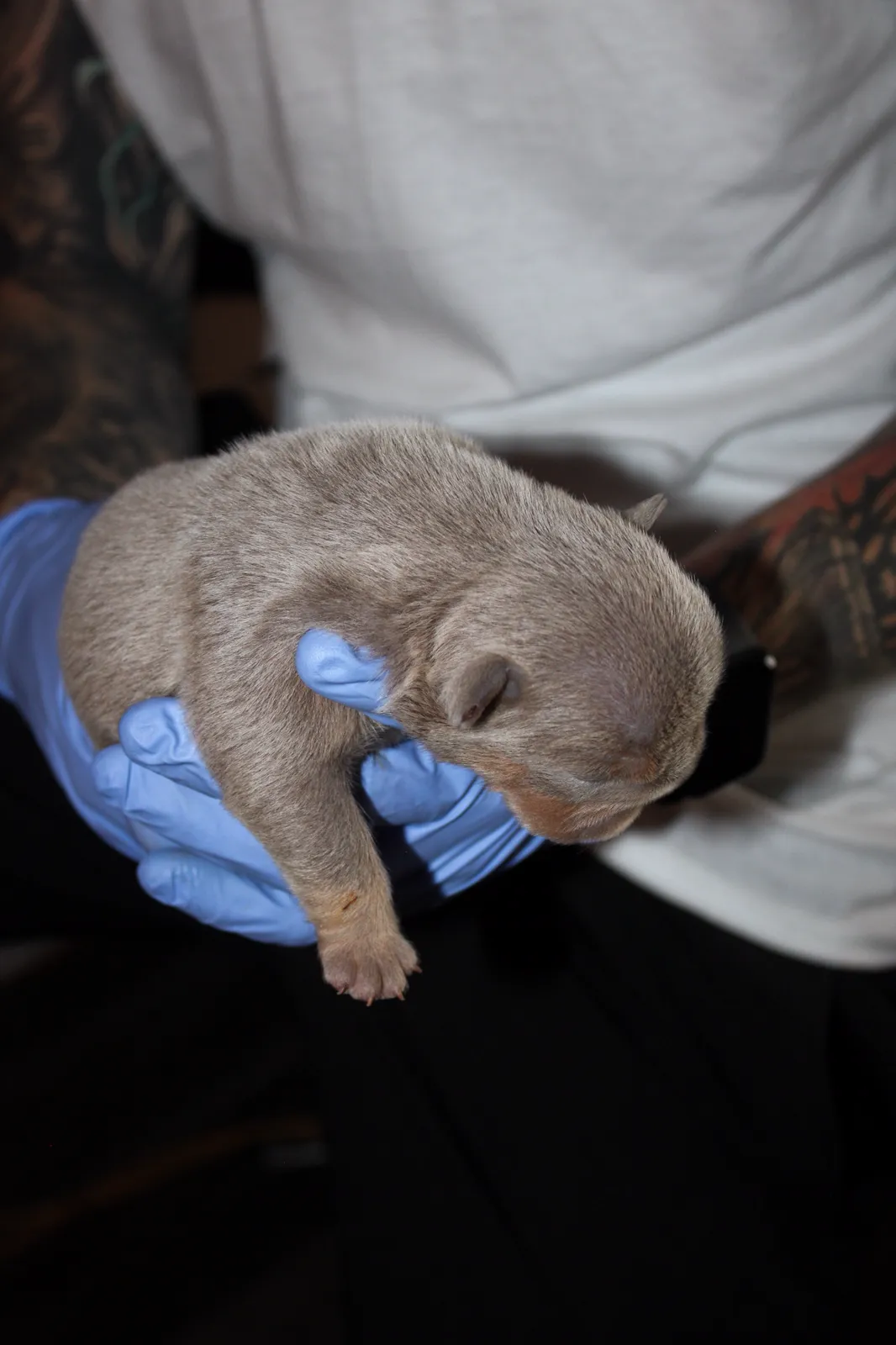
VCA holds treats to no more than 10 percent of a puppy’s daily calories [10], and the same 10 percent rule applies to an adult dog [11]. On a Bulldog puppy that is a very small pile. If you are training, which you should be, use a piece of the measured kibble from that day’s ration and count it. And no extra vitamin or mineral supplements for a growing puppy without checking with your veterinarian first [10]. A complete and balanced growth food already has them in the ratios the puppy needs, and more is not better for a growing skeleton [10][15].
Safety
Calcium is not a supplement you add to a puppy.
More calcium does not build a stronger Bulldog. Excessive calcium can contribute to growth abnormalities in puppies [10], and Merck notes that excess calcium is most problematic in growing dogs from weaning to about one year [15]. That includes calcium tablets, bone meal, and milk. If anyone tells you to add calcium to a puppy’s bowl, the answer is to ask your veterinarian, and the answer from the veterinarian is usually no.
04
Body Condition, Not the Number on the Bag
Two tools do the real work. The first is the scale: VCA has puppies weighed regularly and tracked on a growth chart, and names the Waltham Puppy Growth Charts as the reference [10]. A puppy whose curve bends sharply upward is growing too fast, even if it looks fine. The second tool is body condition scoring. Clinics score dogs on a 1 to 5 scale where 3 is ideal, or a 1 to 9 scale where 4 to 5 is ideal [11]. Ask your veterinarian which scale they use and what your dog scored. Write it down with the date.
The hand check
You can check between visits. Put your hand flat on the dog’s side just behind the front legs and feel the ribs [11]. VCA’s comparison is the one we use at home.
| The ribs feel like | What it means |
|---|---|
| The flesh on the back of your hand | Good condition [11] |
| Your knuckles, or they stick out | Too thin [11] |
| The fleshy part of your palm | Too much weight over the ribcage [11] |
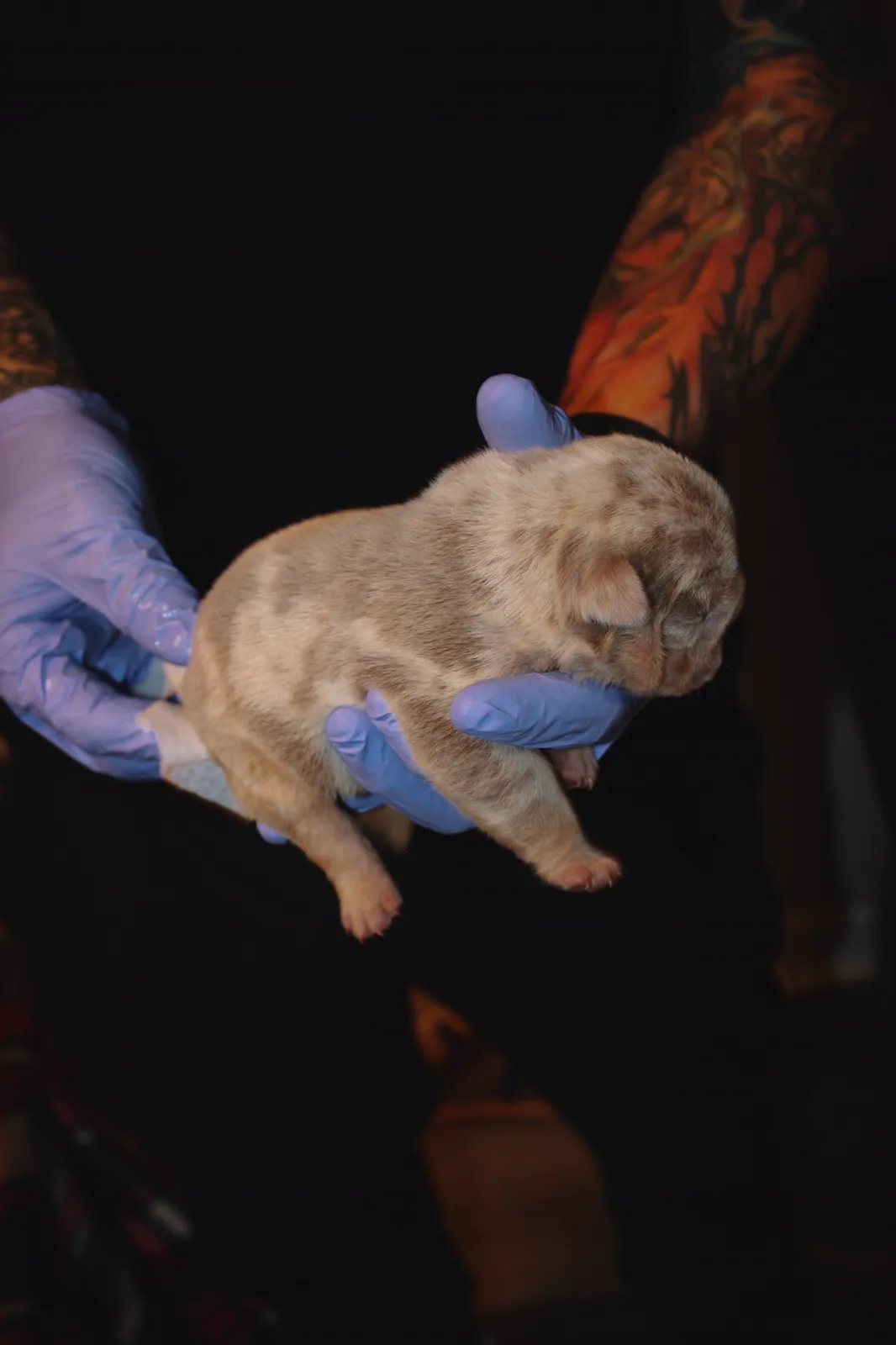
On a Bulldog this check matters more than on most breeds, because the coat is short and the body is wide, and people mistake a thick dog for a healthy dog. A Bulldog with ribs you cannot find under a layer of palm-feeling fat is overweight, however the breed is supposed to look. The hand check tracks progress between weigh-ins [11]. We would add: do it on the same day each week, and have everyone in the house learn it.
If the dog is already heavy
Do not just cut the portion of the current food in half. VCA says reducing the volume of the current food is not recommended because it can lead to micronutrient deficiencies over time, and Merck warns that severely restricting calories on a weight-management diet can cause nutrient deficiencies [11][15]. The approach VCA describes is a restricted-calorie therapeutic diet, a specific portion, a specific meal frequency, no extra snacks, and monthly weigh-ins so the loss is neither too fast nor too slow [11]. Your veterinarian calculates the target weight and sets the plan [11]. Once the dog reaches it, a maintenance food, calorie goal, and daily portion are set with the same team, because regaining is as easy as gaining was [11].
Note
A dog that is heavy on a small ration gets checked, not starved.
VCA lists obesity as a possible sign of hypothyroidism or Cushing’s disease [11], and Merck advises checking for underlying conditions such as hypothyroidism when a dog’s calorie needs seem unusually low [15]. If you are measuring honestly and the dog is still gaining, that is a veterinary visit before it is a smaller cup.
05
The Long-Term Plan for Adults
An adult Bulldog eats a maintenance food, in a measured amount, at the same times every day, for the rest of its life. The interesting decisions are around the edges.
Once your veterinarian says the dog is done growing, the food changes to one whose adequacy statement reads maintenance or all life stages [12]. Merck gives the adult floor: a minimum of 18 percent protein on a dry-matter basis under AAFCO guidelines, with most commercial adult dog foods running 5 to 15 percent fat on a dry-matter basis [15]. Inukshuk 32/32 sits well above that range. That is why we feed less of it and weigh weekly. Any complete and balanced adult food clears that. The number that matters more is the calories, and Merck is honest about how rough the formulas are: any given animal may need as much as 30 percent more or less than the calculated amount, so the calculation is a starting point and the dog’s response sets the rest [15].
That is the whole adult plan. Pick a complete and balanced maintenance food. Start at the bag’s directions. Weigh the dog monthly, do the hand check weekly, and move the portion up or down until the body condition holds. When something changes, a neuter, a new house, a lazier summer, the portion moves again.
Kibble, fresh, raw, home-cooked
People ask us which one is right. We do not sell food, and the sources we read do not settle it either. What the sources do say is about safety and completeness, so that is what we will say.
| Format | What to look for | What the sources flag |
|---|---|---|
| Dry kibble | An adequacy statement for the right life stage [12] | Nothing specific beyond the label and the portion |
| Fresh-cooked commercial | The same adequacy statement. If it reads intermittent or supplemental, it is not a full diet [12] | Refrigeration and shelf life are on you |
| Raw commercial | The same adequacy statement [12], plus strict handling | FDA’s 2010 to 2012 study found raw pet food more likely than other types to carry disease-causing bacteria: of 196 raw samples, 15 tested positive for Salmonella and 32 for Listeria monocytogenes [14] |
| Home-cooked | A recipe formulated by a veterinary nutrition specialist | Merck: nutritional problems occur most commonly when dogs are fed unbalanced homemade diets [15] |
Safety
If you feed raw, the risk is to the people in the house too.
FDA’s position is that raw pet food diets can be dangerous to the pet and to the owners handling the product, through Salmonella and Listeria monocytogenes [14]. Its handling advice: wash hands with soap and water for at least 20 seconds after touching raw food, clean then disinfect surfaces, freeze until use and thaw in the refrigerator rather than on the counter, do not rinse raw meat, keep it separate from other food, refrigerate or discard leftovers promptly, and do not let the dog lick your face [14]. Merck adds that some raw foods carry factors that cooking would destroy, such as avidin in raw eggs and thiaminases in raw fish [15]. We are not telling you not to. We are telling you it is a food-safety job, every day, in a house with kids.

06
Supplements, What the Evidence Says
We looked at what the veterinary sources we read actually support. For most of the list, that is not much.
The sources we cite on this page are general veterinary references, not supplement trials. Where a row below says no veterinary source was reviewed, it means exactly that: we did not find the claim addressed in the pages we read for this guide, and we are not going to borrow a number from a product page to fill the gap. A supplement goes into a Bulldog after a veterinarian who has examined that dog says it should.
| Supplement | What is claimed | What the cited sources support | Our position |
|---|---|---|---|
| Probiotics | Gut health, firmer stool, immune support | No veterinary source reviewed for this guide | Ask your veterinarian |
| Omega-3 fish oil | Skin, coat, joints | Merck: fatty acid supplements are often recommended for dogs with dry, flaky skin and dull coats, after underlying metabolic conditions have been evaluated [15] | Ask your veterinarian, and let them rule out the underlying cause first |
| Glucosamine and chondroitin | Joint support, mobility as the dog ages | No veterinary source reviewed for this guide | Ask your veterinarian |
| Multivitamins and mineral mixes | Fills gaps in the food | VCA: no extra vitamin or mineral supplements for a growing puppy without checking with the veterinarian [10]. Merck: indiscriminate mineral supplementation should be avoided because of the likelihood of a mineral imbalance [15] | Not on a complete and balanced food unless your veterinarian prescribes one |
Your veterinarian decides
A supplement is a decision, not a default.
If a product promises to fix allergies or lengthen life, the promise is the reason to be careful, not the reason to buy. Bring the bottle to your veterinarian. They know what the dog is already eating, what it is already taking, and what could interact. We do not publish amounts and we do not recommend brands, because a supplement that is right for one Bulldog is wrong for the one next to it.
07
Skin, Yeast, and Allergies
Bulldog owners end up on nutrition pages because the dog is itchy. Sometimes food is the answer. Often it is not, and the only way to know is a proper workup.
A Bulldog has folds on its face, a tail pocket, and tight feet, and all of them hold moisture. Skin trouble in this breed is common and it has a lot of causes. VCA describes food allergy as one of the most common allergies in dogs, and notes that many dogs with a food allergy also have atopy, an environmental allergy, or a flea allergy at the same time [13]. In other words, a diet change alone can leave two of three causes untouched.
When food is the problem, the usual culprits are proteins, with VCA naming dairy, beef, chicken, chicken eggs, soy, and wheat gluten as the most common, while noting that nearly any ingredient can be responsible [13]. The signs are itchy skin, paws, or ears, and sometimes digestive upset such as vomiting or diarrhea [13]. Because the immune system has to build up to it, signs usually show up after a long stretch on one food, not the week after a change [13].
How it actually gets diagnosed
The most accurate method VCA describes is an elimination trial: a hypoallergenic diet, prescribed by the veterinarian, fed for 8 to 12 weeks, with no other foods, treats, or supplements during the trial, including flavored vitamins and some flavored parasite preventives [13]. If the signs resolve, the old food is reintroduced as a challenge, and a food allergy is confirmed if the signs come back within a week [13]. The strictness is the whole test. One flavored chew from a visitor resets the clock.
The diets used are veterinary hydrolyzed-protein diets, which break proteins into pieces too small for the immune system to recognize, or veterinary novel-protein diets built around a protein the dog has never eaten [13]. VCA notes that retail limited-ingredient foods are not made under the same strict protocols against cross-contamination as veterinary diets [13], which is why a store-shelf swap is not the same as a trial. A home-prepared novel-protein diet has to be formulated by a veterinary nutrition specialist and usually needs a balancing supplement [13].
Note
Recurring yeast or itch is a veterinary workup, not a food hunt.
There is no cure for a food allergy; avoidance is the treatment, some dogs need medication through a bad flare, and a dog with one food allergy can develop another later [13]. Merck’s advice on skin and coat supplements is the same: evaluate underlying conditions first [15]. We will not tell you that any food or supplement fixes a Bulldog’s skin, because the sources do not.
08
Feeding the Dam
A brief note for breeders. The full pregnancy guide is where this lives.
A pregnant and nursing Bulldog is on a different plan from the pet in the house, and the whole of it is in our pregnancy and whelping guide, linked below. The nutrition facts worth repeating here: VCA moves the dam onto a puppy or growth food in the third trimester, but not a large-breed puppy food [9]. Peak lactation, at three to five weeks after whelping, can run two to four times a non-pregnant adult’s calories [9]. AAFCO treats gestation and lactation as its own life stage on the adequacy statement [12], which is why the label matters as much for her as for the puppies.
And the fact that ties this page together: obesity is the most common nutrition problem in breeding dogs [9]. The dam that is fit before breeding is the one that has the easier pregnancy and recovery. Body condition does not stop mattering because a dog is working.
Note
Calcium for the dam is in the pregnancy guide.
Calcium during pregnancy and nursing is a specific, veterinarian-decided question with its own risks, and we keep it in one place so it is not half-stated here. Read the eclampsia section of the pregnancy and whelping guide before the litter, not after.
09
Questions We Get
What food do you feed, and do I have to keep feeding it?
Your puppy comes home with the food it has been eating, Inukshuk Professional 32/32. Keep it for at least two weeks. After that, the food is a decision between you and your veterinarian. Our only requirement is that whatever you pick carries an AAFCO statement for growth or all life stages while the dog is growing [10][12], and that you measure it.
How many times a day should a Bulldog puppy eat?
VCA’s guidance is measured portions two to three times a day with no free-choice feeding [10]. The meal count your puppy is on is written on its care sheet. When to drop a meal is a conversation with your veterinarian as the puppy grows.
Should a Bulldog be on large-breed puppy food?
VCA ties large-breed growth food to large and giant breeds, which have the highest risk of growth abnormalities [10], and Merck says excess calcium is most problematic for growing large- and giant-breed dogs [15]. A Bulldog is a heavy-boned dog that is not large by weight. Your veterinarian, looking at your puppy, makes that call. We will not make it from a web page.
My Bulldog is itchy. Should I change the food?
Not on your own. Food allergy is one common cause, and many dogs with food allergy also have environmental or flea allergy [13]. The test that answers the question is a veterinarian-run elimination trial of 8 to 12 weeks with nothing else fed [13]. Swapping bags without the trial usually tells you nothing.
Do you recommend any supplement?
No. We do not publish amounts and we do not recommend brands. The sources we read support fatty acid supplements for some dogs with dry, flaky skin after a veterinarian has ruled out the underlying cause [15], and warn against indiscriminate mineral supplements and against adding vitamins or minerals to a growing puppy without veterinary advice [10][15]. For the rest of the list, we found no veterinary source for this guide. Ask your veterinarian.
References
Numbers in brackets point here. Each page was read on the date shown and the figures on this guide were checked against it. Where two sources differ, both are given.
- [7]American Kennel Club. Closing the Milk Bar: The Puppy Weaning Process. https://www.akc.org/expert-advice/dog-breeding/closing-milk-bar-puppy-weaning-process/ Accessed 2026-10-18
- [9]VCA Animal Hospitals. Feeding the Pregnant Dog. https://vcahospitals.com/crowfoot/know-your-pet/feeding-the-pregnant-dog Accessed 2026-10-18
- [10]VCA Animal Hospitals. Feeding Growing Puppies. https://vcahospitals.com/know-your-pet/feeding-growing-puppies Accessed 2026-10-18
- [11]VCA Animal Hospitals. Obesity in Dogs. https://vcahospitals.com/know-your-pet/obesity-in-dogs Accessed 2026-10-18
- [12]Association of American Feed Control Officials (AAFCO). Reading Labels. https://www.aafco.org/consumers/understanding-pet-food/reading-labels/ Accessed 2026-10-18
- [13]VCA Animal Hospitals. Food Allergies in Dogs. https://vcahospitals.com/know-your-pet/food-allergies-in-dogs Accessed 2026-10-18
- [14]U.S. Food and Drug Administration. Get the Facts! Raw Pet Food Diets can be Dangerous to You and Your Pet. https://www.fda.gov/animal-veterinary/animal-health-literacy/get-facts-raw-pet-food-diets-can-be-dangerous-you-and-your-pet Accessed 2026-10-18
- [15]Merck Veterinary Manual. Nutritional Requirements and Related Diseases of Small Animals. https://www.merckvetmanual.com/management-and-nutrition/nutrition-small-animals/nutritional-requirements-and-related-diseases-of-small-animals Accessed 2026-10-18
Educational only, not veterinary advice. Godspeed Bulldogs is a breeding kennel, not a veterinary practice. Nothing on this page replaces the judgment of a licensed veterinarian who has examined your dog. Talk to your veterinarian before using any medication, supplement, fluid, feeding technique, or schedule described here.